


Deep-sea fauna
Abyssal creatures: what secrets do the ocean depths hold?
After centuries of research, the species that populate the Earth are well known, at least those that are within our reach. Because there are others, present in remote and practically inaccessible places, which are largely unknown. These include those found in the deep sea. Below, we take a closer look at the abyssal creatures that inhabits the seas and oceans of our planet.
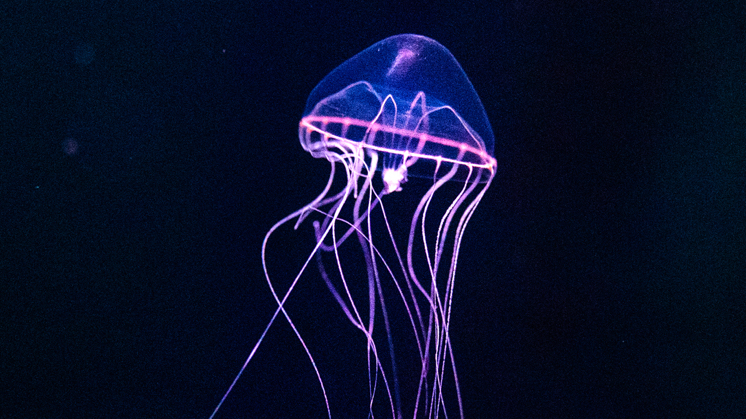
Several hundred metres below sea level, where light cannot penetrate, there are thousands of species that have made the deep sea their habitat. Animals such as the viperfish, the telescope octopus and the vampire squid are just three of the thousands of species that, according to the Census of Marine Life , live in the deep sea.
These thousands of species, many of which researchers have discovered over the last few decades thanks to the Ocean Biodiversity Information System (OBIS), make up the deep-sea fauna – that is, those living at depths of 200 metres or more. Although there are many, scientists agree that more than 80% of the ocean floor has not yet been surveyed using modern technology, so the secrets of the deep have only just begun to be revealed.
What is the abyssal zone?
The abyssal zone, also known as the abyssopelagic zone, is one of the levels into which the oceans are divided and it is found between 3,000 and 6,000 metres below the surface. In fact, the word abyssal comes from the Latin abyssalis, meaning abyss, something bottomless or extremely deep. However, we must distinguish between abyssal fauna and deep-sea fauna. From a zoological point of view any fauna living at depths of 200 metres or more is considered deep-sea fauna, as very few species are capable of living beyond 1,000 metres.
Why is abyssal fauna important?
Abyssal fauna helps the oceans to function as a balanced living system, capable of regulating the climate and sustaining thousands of species, including humans. Animals in the deep sea feed on matter that falls from the surface (fish remains, plankton and even whales), thereby preventing it from accumulating and rotting on the seabed, maintaining the balance of the marine food chain and linking life at the surface with that in the deepest zones.
As organic matter decomposes it helps to store some of the carbon in the seabed sediments for long periods of time and at the same time releases nutrients which, thanks to ocean currents, can return to shallower areas and feed phytoplankton – the basis of marine life and a major source of oxygen for the planet. If these processes are disrupted the ocean loses its ability to absorb carbon dioxide and to maintain its ecological balance. Activities such as deep-sea mining can damage these ecosystems and put thousands of species at risk, with knock-on effects on the health of all marine life.
Furthermore, thousands of species have already been described in the deep sea, and it is suspected that there are many more yet to be discovered. Studying them helps us to better understand how the ocean works, how life adapts to extreme conditions and what risks are involved in altering these environments amid the climate crisis; thus, protecting abyssal fauna also means protecting our future ability to understand the planet.
Characteristics of the abyssal zone
The abyssal zone, due to its depth, is an extremely demanding environment for living beings: it is an aphotic region, i.e. it lacks light; the temperature ranges between 0 ºC and 3 ºC; there is a shortage of nutrients, which makes it difficult for the species that inhabit it to feed and grow; and the hydrostatic pressure increases with depth, for example, in the Challenger Deep, the deepest point of the ocean at almost 11,000 metres, the pressure is a thousand times higher than at sea level.


What is the abyssal plain?
The abyssal plain is a practically flat strip of land typical of the abyssopelagic zone that extends beyond the continental shelf, the continental barrier and the continental rise. It makes up about 50 % of the ocean floor and below it we would only find the oceanic trenches, that can reach a depth of 11,000 metres — such as the Challenger Deep, mentioned above, which is located at the southern end of the Mariana Trench. Light does not reach the plain, so it harbours little life, mainly chemosynthetic bacteria, some invertebrates (worms) and some vertebrates (fish).
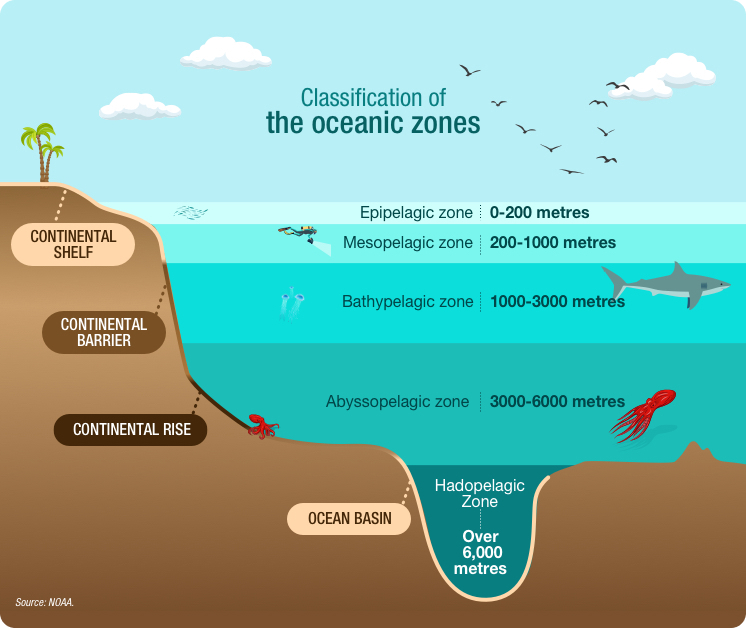
 SEE INFOGRAPHIC: Classification of the oceanic zones [PDF] Enlace externo, se abre en ventana nueva.
Deep-sea fauna
Ever since the British government launched the Challenger expedition in 1872 to map the deep sea, discovering forty new species, there have been numerous scientific voyages that have gradually unravelled a small percentage of its mysteries. The expeditions by the research teams of the US National Oceanic and Atmospheric Administration (NOAA) or those by the aforementioned OBIS are a good example of this.
In 2018, an Australian expedition discovered more than 100 species of abyssal fish at a depth of 4,800 metres, some of them faceless, i.e. without visible eyes or mouths, others terrifying, such as the lizardfish with a huge mouth, photos of which went viral. Their appearance is justified by their harsh living conditions, as they have had to adapt to the environment in order to survive, and this gives them a very special set of attributes: soft bodies, transparent skins, sharp teeth, underdeveloped eyes, extendable stomachs, etc. One of the most recent discoveries was the snailfish in 2019, thanks to a group of researchers from the Monterey Bay Aquarium Research Institute (MBARI) in California, USA.
If there is one feature that stands out above all others, it is bioluminescence. This phenomenon, which occurs in 90 % of the animals living in the deep sea, allows them to create light through a chemical reaction, which they use for defence, to locate food or as a lure for reproduction. Bioluminescence can be diffuse, localised or appear in specialised organs.
Here are some examples of the amazing abyssal creatures:
-

Deep-sea fish
-
Abyssal anglerfish: Members of the family Caulophrynidae, Abyssal anglerfish are characterised by a stalk above their mouth, at the tip of which is a light-emitting organ that they use for hunting. As they live on the abyssal seabed, they find it difficult to find a mate, so the female, which is larger, acts as a host to the male.
-
Viperfish: With the scientific name Chauliodus danae, it has disproportionately large and very sharp teeth that allow it to impale its prey. Males can grow up to 15 centimetres in length. Chauliodus sloani, from the same family and larger in size, inhabits waters up to 4,000 metres deep.
-
Pelican eel: Scientifically known as Saccopharynx, these eel-like fish have expandable stomachs, enormous jaws – which give them the nickname “gulper eel” – and a bioluminescent organ at the tip of the tail. They live at depths of around 2,000 metres and can reach up to two metres in length.
-
-

Deep-sea crustaceans and deep-sea molluscs
-
Giant sea spider: scientifically known as Colossendeis, this genus of sea spiders – some of which are bioluminescent – lives in deep waters and is notable for the length of its limbs, which can reach 40 to 50 centimetres, in contrast to its small body.
-
Vampire squid: scientifically known as Vampyroteuthis infernalis, it can live in the deep sea and lacks an ink sac; instead, it releases a sticky cloud of bioluminescent mucus to scare off its predators.
-
Telescope octopus: its scientific name is Amphitretus pelagicus and it inhabits the tropical and subtropical waters of the Indian and Pacific Oceans. It differs from other octopus species in that it is translucent and has tubular eyes.
-


Viperfish

Abyssal anglerfish

Squid in the depths of the ocean
The impact of pollution on deep-sea fauna
Plastic pollution in the oceans has caused microplastics to reach the deepest depths. Now this remote part of the planet has become a sort of sink or repository for these polluting particles, affecting this precious ecosystem and causing irreversible damage to the marine species that inhabit this area. According to a study carried out in the US by the National Centre for Biotechnology Information in 2026, microplastics were detected in all specimens of Myxini, a lineage of deep-sea fish dating back more than 300 million years. Researchers detected a predominance of hazardous high-density polymers, particularly polyvinyl chloride, in their gastrointestinal tract, raising concerns about potential implications for their health and survival.
Cases such as this species serve as a reminder that pollution is seriously affecting all species on the planet, with marine fauna being the hardest hit by the presence of plastics. This, in turn, poses a serious threat to food safety as these polluting particles are transferred to humans.
Other threats to deep-sea fauna
Deep-sea fauna faces an unprecedented combination of threats. These range from the effects of climate change to underwater noise, which threatens the wellbeing of species.
-

Climate change and ocean warming
Global warming has raised the average temperature of the ocean, and some of that heat is penetrating into the deep waters, altering currents and oxygen availability. In the abyssal zone even small increases in temperature can alter metabolic rates and food availability, due to the migration of species caused by declining oxygen levels, thereby threatening species that have adapted to very stable conditions over millions of years.
-

Underwater noise
Increased maritime traffic, seismic exploration and industrial activities are generating a rise in low- and medium-frequency noise that propagates to great depths. Bobbi-Jo Dobush is a specialist in the economics and legal liability of deep-sea mining. In an interview conducted by Greenpeace in 2025, she stated that activities such as seabed mining could affect the ocean's ability to sequester carbon and disrupt the food chain and species' habitats, as well as impacting economies that depend on fishing.
-

Ocean acidification
The excessive absorption of carbon dioxide by the ocean is lowering the pH of seawater – a phenomenon known as ocean acidification – harming biodiversity, fisheries and the balance of marine ecosystems, and consequently also the habitats of abyssal species.
-

Deep-sea fishing
Activities such as trawling are one of the main threats to marine species living in the deep sea. According to a study carried out by researchers at the Autonomous University of Barcelona (UAB) in 2014, intensive trawling causes, in the long term, the biological desertification of sedimentary ecosystems on the seabed, damaging their organic carbon content and the abundance of their fauna.


New technologies for exploring the ocean depths
New technologies for exploring the deep ocean are transforming our ability to understand one of the most inaccessible environments on the planet. Remotely operated vehicles (ROVs) and autonomous underwater vehicles (AUVs) can reach depths of thousands of metres equipped with high-definition cameras, robotic arms and multiple sensors, collecting images, biological samples and physical data without putting people at risk. Vessels such as the National Oceanic and Atmospheric Administration (NOAA) Ship Okeanos Explorer and the Nautilus, designed by the Ocean Exploration Trust (OET), use these systems to explore deep-sea habitats, geological formations and maritime heritage sites.
Molecular biology has also taken centre stage in deep-sea exploration through environmental DNA (eDNA). This technique allows the presence of species to be detected from the genetic material they leave behind in the water, without the need to capture them directly, which is particularly useful in remote and fragile environments.
Finally, live expeditions and telepresence have opened the deep ocean to the scientific community and the global public. The organisation NOAA Ocean Exploration provides live streams from the Nautilus, allowing people to follow explorations into the depths of the ocean in real time.
Myths and realities of deep-sea fauna
-

Myth: All deep-sea animals are enormous
Fact: Deep-sea fauna exhibits a wide diversity of sizes and morphologies, ranging from small gelatinous invertebrates and soft-bodied fish to some large predators – a phenomenon known as abyssal gigantism.
-

Myth: There is no life where light does not reach.
Fact: In the absence of light many organisms depend on particles of organic matter falling from the surface. NOAA Ocean Exploration expeditions have documented rich communities of invertebrates, fish and microbes in areas of complete darkness.
-

Myth: The seabed is untouched and free from human impact
Fact: Studies have already shown that the seabed bears traces of human activity such as microplastics.
-

Myth: The deep sea is all the same
Fact: The deep sea is extremely diverse and includes canyons, abyssal plains, mountains and sites of marine heritage, each with its own regions and ecological processes.


Iberdrola, committed to protecting marine biodiversity
It is not only abyssal fauna that is at risk from pollution, but also the entire spectrum of marine biodiversity, from coastal ecosystems to deep-sea habitats. Protecting these systems is particularly important in the development of offshore projects, where activities such as construction, underwater noise or the occupation of marine space can affect marine mammals, birds, fish and benthic communities.
For this reason, at the Iberdrola Group we are committed to developing conservation strategies to protect the species that inhabit the countries where we operate. Among these strategies is our Biodiversity Plan 2030 through which we aim to make a positive contribution by reducing, restoring and offsetting impacts. With this plan we seek to avoid installing facilities in areas of high ecological value, reduce pollution and restore affected habitats.
In offshore wind projects this translates into concrete measures. For example, in projects such as Saint Brieuc we implemented a marine mammal protection protocol to mitigate the potential impacts of underwater noise through best-practice measures. This included deploying an observer to monitor the presence of marine mammals within the mitigation zone and to implement the necessary protective measures, such as halting operations should these animals be detected. Another project of particular importance is New England Wind, where protocols are in place to minimise the impacts of underwater noise on marine life, thereby helping to safeguard the welfare of deep-sea fauna.
In addition to carrying out these projects we aim to minimise greenhouse gas emissions and achieve carbon neutrality through electrification and decarbonisation of our operations, with the aim of reducing the use of fossil fuels and committing to a more sustainable economy. In this way we address the protection of marine biodiversity both at a local level – through preliminary environmental studies, impact mitigation and restoration programmes – and at a global level by reducing the climate-related threats affecting the oceans and their depths.
To find out more about our areas of work please consult our Iberdrola Biodiversity Report, which details our objectives, actions and results in the field of nature conservation, including specific initiatives in the marine environment.