


Interview with Lucía Agirre & Tracey Bashkoff
"Hilma af Klint has changed the uniform, masculine discourse on abstraction, and let's hope this continues"
Hilma af Klint (1862-1944) kept her work largely invisible for a long period. In fact, it was not until long after her death, in 1986, that the general public was able to discover some of her paintings, which were filled with forms, colours and symbolism. Now, her enigmatic work is once again in the spotlight. Curated by Lucía Agirre and Tracey Bashkoff, the exhibition ‘Hilma af Klint’ arrived at the Guggenheim Museum Bilbao in collaboration with Iberdrola to showcase the remarkable story and essence of the Swedish artist’s work, considered a pioneer of abstract art ahead of names such as Kandinsky and Mondrian.
 Publication: October 2024
  Reading time: 9 minutes
Exhibition dates: 18 October 2024 – 11 February 2025

Photograph of the Swedish artist Hilma af Klint (1862–1944) at her studio on Hamngatan in Stockholm. Courtesy The Hilma af Klint Foundation ©The Hilma af Klint Foundation, Bilbao 2024.
Key points from the interview and the exhibition:
- Hilma af Klint, a pioneer of abstraction before Kandinsky and Mondrian.
- A revision of the historical narrative with the contribution of women to artistic avant-gardes.
- Spirituality, symbolism and invisible knowledge expressed through geometry, colour and esoteric references.
- Work created between the late 19th and early 20th centuries, remaining largely unknown until decades after her death.
- International recognition and rediscovery through the exhibition ‘Hilma af Klint’.
The exhibition
Hilma af Klint exhibition will be on display at the Guggenheim Museum until February 2025. What will visitors find there?
The exhibition will be a comprehensive survey of the career of Swedish artist, that spans from her early works on traditional themes, her automatic drawings and her most outstanding series, including Paintings for the Temple, Parsifal, the Atom Series, to the watercolors of her final years.
This will be one of the biggest, if not biggest show, of Hilma af Klint work hosted in Spain?
Most probably yes, because there have been other shows in Spain previously, but the exhibition plans to dramatically engage the space of the museum, arranging the show throughout the entire second floor of Frank Gehry’s magnificent building. Accordingly, we are showing some large format works or entire series that have not been on view or only partially in other exhibitions.
"Coming to believe the world was not yet prepared to accept her work, Hilma af Klint took pains to store and catalog it so that the society of the future would receive it in an orderly fashion"
Lucía Agirre
Hilma af Klint and abstraction
Hilma af Klint is particularly well known as a pioneer of abstract art, there have been some recent shows that put her art in dialogue with other artists, such as Kandinsky and Mondrian, do you consider that her late “discovery” has changed the discourse on abstraction?
Absolutely, not only Hilma af Klint, other women such as Georgiana Houghton or Olga Fröbe-Kapetyn, among others, have changed the uniform and male-focused discourse on abstraction, and hopefully this will continue to happen, not only on abstraction, but in other spheres of the history of art and life too.
Her abstract artwork was rarely seen in public during her lifetime, and it is only in the last few decades, years after her death, that her paintings and works on paper have been revealed to the public. What were her reasons for this?
She exhibited her production in her lifetime, but mostly her more traditional figurative paintings. She rarely presented her abstract art publicly, and never showed it in mainstream artworld settings. She instead sought to share it with likeminded spiritual communities but struggled to find an enthusiastic audience. Coming to believe the world was not yet prepared to accept her work, Hilma af Klint took pains to store and catalog it so that the society of the future would receive it in an orderly fashion.
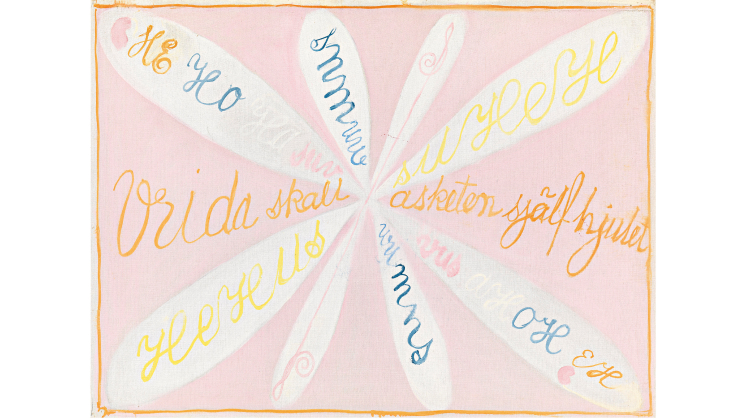
Eros Series, The WU/Rose Series, Group II (Erosserien, Serie WU/Rosen, Grupp II), n.º 5, 1907. Courtesy The Hilma af Klint Foundation, Stockholm, HaK 31. ©The Hilma af Klint Foundation, Bilbao 2024.
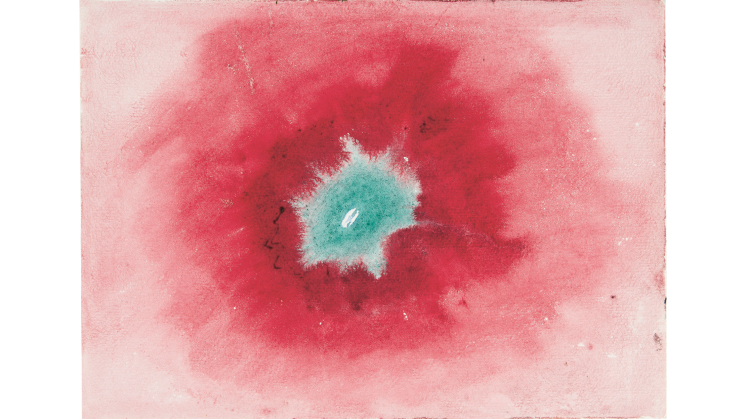
Untitled, On the Viewing of Flowers and Trees (Titel saknas, Vid betraktande av blommor och träd), 1922. Courtesy The Hilma af Klint Foundation, Stockholm, HaK 615. ©The Hilma af Klint Foundation, Bilbao 2024.
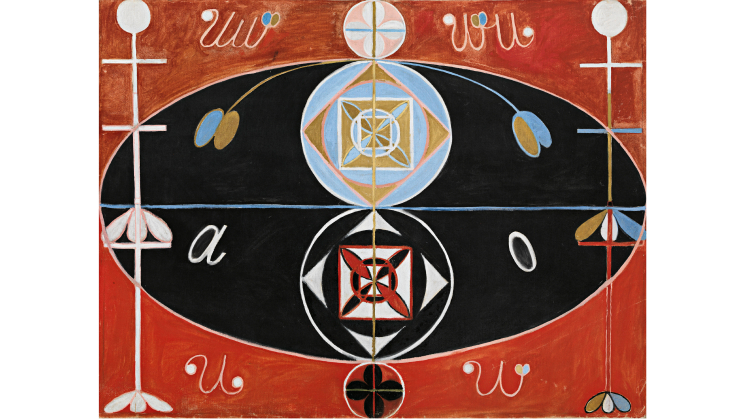
The Evolution, The WUS/Seven-Pointed Star Series, Group VI (Evolutionen, Serie WUS/Sjustjärnan, Grupp VI), n.º 16, 1908. Courtesy The Hilma af Klint Foundation, Stockholm, HaK 84. ©The Hilma af Klint Foundation, Bilbao 2024.
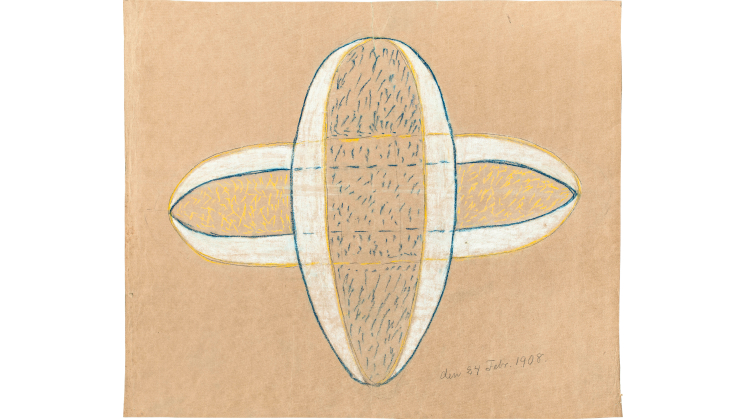
Untitled, The Five (Titel saknas, De Fem), 1908. Courtesy The Hilma af Klint Foundation, Stockholm, HaK 1252. ©The Hilma af Klint Foundation, Bilbao 2024.
Training and the status of women artists
The Royal Swedish Academy of Arts, was one of the first in Europe to allow women to take life drawing classes. What is known about her time at this school, and how did her studies forge her relationship with art?
It was not until 1864 that the female department of the Royal Swedish Academy of Fine Arts, Fruntimmersavdelningen, was opened, where for the first time women could receive a complete artistic education as students, allowing them to draw from a live model. Hilma af Klint enrolled in the Academy in 1882, at the age of almost 20, afterwards her studies at the technical school, and in the academy of Kerstin Cardon, of the first women to be admitted to the Royal Academy of Fine Arts. However even in this forward-thinking institution, women were thought to be copyists, while men were seen as artists. Yet most significantly, at the Academy, af Klint found ground for understanding and union among women artists.
What difficulties did she have in integrating into the artistic field of late 19th and early 20th century Europe simply because she was a woman?
The af Klint family was a fundamental support, since they understood that the education of their daughters, as well as that of the male members of the family, was important. To became an artist, in the case of women, was intended for upper and upper-middle class females, who had family resources, both to pay for their training and to facilitate the dedication that this entailed, in a society in which marriage was a natural socio-economic outlet for many women.
It was also complicated for this artist to show their work in public, therefore in 1910 was founded the Association of Swedish Women Artists (FSK), in which Hilma af Klint served as secretary for a short period of time. Through this association, the female artists who left the academy managed to have their work exhibited in public, which did not prevent important critics from continuing to denigrate their work and recommending that they devote themselves to "their work" at home.
"Hilma af Klint saw no contradiction between the spiritual and scientific realms. In fact, she believed that both were means of attaining a higher truth"
Tracey Bashkoff
Spirituality and symbolism
A closer look at her story also reveals that she was a person very much linked to mysticism, spirituality and the beyond. How was this reflected in her work?
Like many of her contemporaries, Hilma af Klint saw no contradiction between the spiritual and scientific realms. In fact, she believed that both were means of attaining a higher truth. In 1906, Hilma af Klint began her most important and ground-breaking project, on which she spent almost a decade. Her Paintings for the Temple comprise a total of 193 paintings and drawings in which the artist set aside her formal education to instead create a new, nonobjective art informed by her relationship with spiritualism and other philosophies, such as Rosicrucianism, Theosophy, and later Rudolf Steiner’s Anthroposophy.
The shapes in her works are very diverse: circles, spheres, pyramids, animals, flowers, and so on. How do these elements translate into her art and what meaning do they have?
In the 1930s, in an attempt to explain her cryptic systems of words, symbols, colors and letter combinations, the artist compiled in a notebook entitled, Letters and Words pertaining to Works by Hilma af Klint some definitions. While she provides this fascinating lexicon, words and letters often had multiple meanings, some complicated and confusing. Still, it can be illuminating and thought-provoking. For example, the rose or red stands for selfishness, a temple represents individuality, the snail or spiral represents development or evolution, letter W may represent matter while the U may stand for the spirit, making WU a duality, and many other curious symbols.
One of her most known series is the one devoted to the swan. What is the meaning of the swan figure in her paintings?
The swan appears in several series, but one is specially devoted to this bird. In addition to the Swan’s significance in mythology and ancient legends, for Helena Blavatsky, founder of Theosophy, this bird symbolized the grandeur of the spirit.
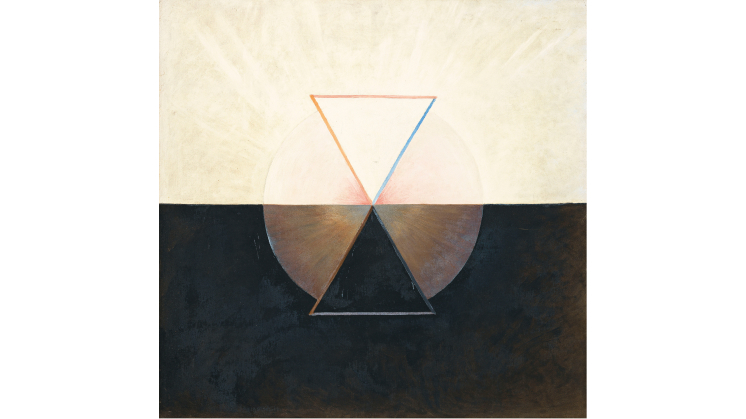
The Swan, The SUW/UW Series, Group IX/SUW (Svanen, Serie SUW/UW, Grupp IX/SUW), n.º 13, 1915. Courtesy The Hilma af Klint Foundation, Stockholm, HaK 161. ©The Hilma af Klint Foundation, Bilbao 2024.
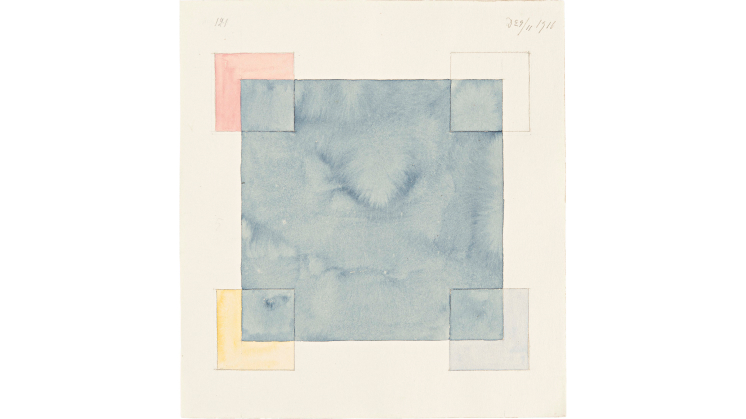
The Parsifal Series, Grupo III (Serie Parcifal, Grupp III ), n.º 121, 1916. Courtesy The Hilma af Klint Foundation, Stockholm, HaK 327. ©The Hilma af Klint Foundation, Bilbao 2024.
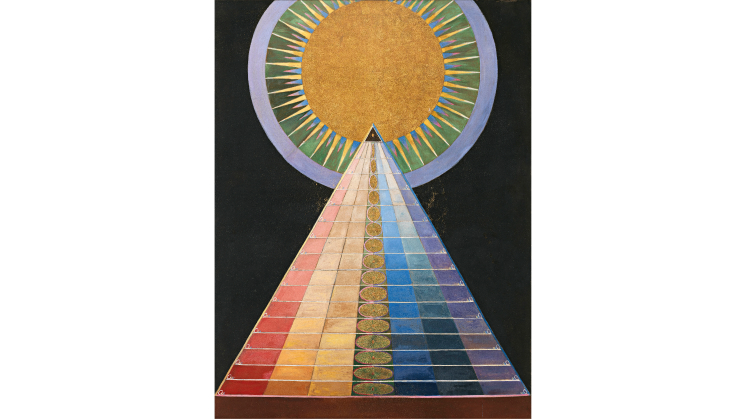
Altarpiece, Altarpieces, Group X (Altarbild, Altarbilder, Grupp X), n.º 1, 1915. Courtesy The Hilma af Klint Foundation, Stockholm, HaK 187. ©The Hilma af Klint Foundation, Bilbao 2024.
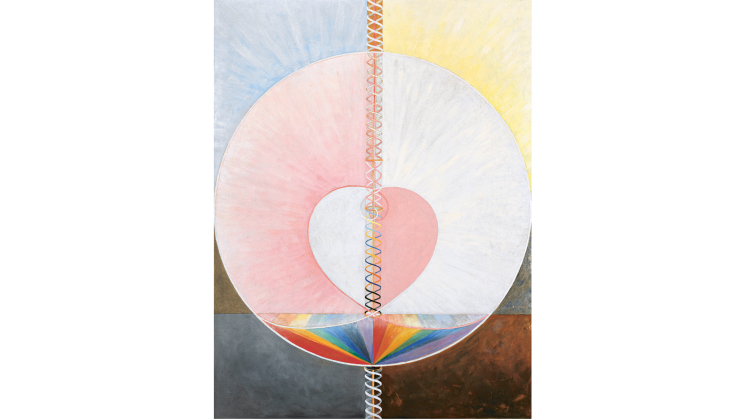
The Dove, The SUW/UW Series, Group IX/UW (Duvan, Serie SUW/UW, Grupp IX/UW), n.º 1, 1915. Courtesy The Hilma af Klint Foundation, Stockholm, HaK 173. ©The Hilma af Klint Foundation, Bilbao 2024.
Notable works
What other works would you highlight from the exhibition and why?
In addition to the Paintings for the Temple, her most important and ground-breaking project on which she spent almost a decade, we like specially the series On the Viewing of Flowers and Trees watercolors from 1922, when influenced by Rudolf Steiner who believed that close observation of the natural world would allow one to experience the spiritual world, she changed her entire approach to making art and began to paint, watercolors of botanical forms that aspired to portray the spiritual forces of nature. The artist used a wet-on-wet technique for these works that involved moistening the paper with a damp sponge so the paint could run freely when applied, letting the colors generate the subject matter.
Support for the arts
What is Iberdrola's role in the exhibition and why is it important that large companies support art?
Iberdrola through its continuous support to the Guggenheim Museum Bilbao and specially to the female voices, such as Hilma af Klint or Alice Neel, among others, is contributing to a more expansive and inclusive way of writing the history of art.

Why Hilma af Klint changed the history of art
When Hilma af Klint’s work came to international attention decades after her death in 1944, it forced a reassessment of one of the most established narratives in modern art history. Her abstract paintings, created years before those of Wassily Kandinsky, Piet Mondrian or Kazimir Malevich, demonstrated that abstraction had begun earlier and in a more diverse way than previously thought. Her work challenged the idea that these male artists were the sole founders of one of the most influential movements of the 20th century.
Beyond her pioneering chronology, af Klint opened up new ways of understanding the relationship between art, spirituality and knowledge. Her compositions combine geometry, colour, symbolism and scientific references in an innovative visual language that anticipated many later movements. Her rediscovery has not only expanded the canon of modern art, but has also contributed to recognising the role of women artists in the development of international avant-garde movements.
Iberdrola and the Guggenheim Museum Bilbao: promoting contemporary culture since the museum was born
The collaboration between Iberdrola and the Guggenheim Museum Bilbao is one of the strongest examples of support for contemporary culture in Spain. This partnership, which dates back to the museum’s opening in 1997, has helped promote art and contemporary creativity as tools for social transformation. Both institutions share a vision that sees culture as a driver of knowledge, creativity and social cohesion, encouraging access for increasingly diverse audiences. For Iberdrola, this commitment forms part of its dedication to social sustainability and to the cultural development of the communities in which it operates.