


News
The town of Sigüenza in Castilla-La Mancha is hosting the third edition of the Convive Awards
Ten initiatives transforming rural areas receive recognition from Iberdrola


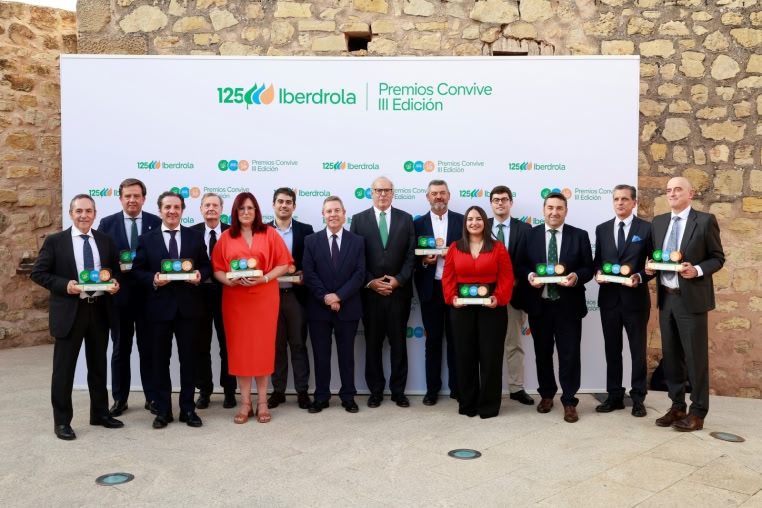
Birka Composites, Bayer Spain, the Basque Government, Lucena Town Council and AFAR (Association of Andalusian Refrigeration Manufacturers), the newspapers Diario Las Provincias (Valencian Community) and El Comercio (Asturias), UNICEF, Silvia Gómez, chair of the La Costana neighbourhood association (Cantabria), and the town councils of Víllora and Enguídanos (Cuenca), have been awarded prizes in this third edition.
 Ten initiatives transforming rural areas receive recognition from Iberdrola [PDF]
 - Birka Composites, Bayer Spain, the Basque Government, Lucena Town Council and AFAR (Association of Andalusian Refrigeration Manufacturers), the newspapers Diario Las Provincias (Valencia region) and El Comercio (Asturias), UNICEF, Silvia Gómez, chair of the La Costana neighbourhood council (Cantabria), and the town councils of Víllora and Enguídanos (Cuenca), have been honoured at this third edition of the Convive Awards.
- The ceremony was attended by Mario Ruiz-Tagle, CEO of Iberdrola España; Emiliano García-Page, President of the Regional Government of Castilla-La Mancha; María Jesús Merino Poyo, Mayor of Sigüenza; Pablo Bellido, President of the Regional Parliament of Castile-La Mancha; Mercedes Gómez, Regional Minister for Sustainable Development; Bárbara García Torijano, Regional Minister for Social Welfare; and Álvaro Martínez Chana, President of the Cuenca Provincial Council.
Iberdrola brought together more than 150 people today in Sigüenza (Guadalajara) for the presentation of its Convive Awards. In this third edition, the company highlighted the potential of rural areas to drive progress, create opportunities and lead the energy transition.
The awards recognise the best initiatives promoting environmental, agricultural and social harmony with clean energy. This year, the company honoured 10 initiatives across six categories, demonstrating that these opportunities extend beyond renewable energy production to include electricity networks, the electrification of the economy and the manufacture of products required by this transition.
Iberdrola España CEO Mario Ruiz-Tagle highlighted that “electrification will be one of the major economic drivers of the 21st century and an essential response to strengthening Europe's energy security, competitiveness and decarbonisation. It is fundamental to improving people's lives, creating jobs and generating lasting opportunities in local communities.”
“With the Convive Awards, we want to recognise that economic progress, social cohesion and nature protection can and must move forward together. Electrification will be faster, fairer and more robust if it is built through collaboration, listening to communities and leaving a tangible value in every area,” Ruiz-Tagle said.
The winners of this third edition of the Convive Awards were:
In the Innovation with Impact category: Birka Composites for demonstrating that electrification and the protection of biodiversity can go hand in hand, with an innovation born in a rural setting that creates skilled jobs for young people and turns the coexistence of development and nature into a replicable industrial model. The jury also recognised Bayer Spain's project for the total decarbonisation of the manufacturing process for the active ingredient in Aspirin in Asturias, for demonstrating that electrification can also transform demanding industrial thermal processes. This pioneering initiative reduces process emissions to virtually zero, avoiding more than 10,000 tonnes of CO₂ per year and establishing itself as a national and international benchmark for industrial decarbonisation.
In the Biodiversity Conservation category: the Basque Government's "Urdaibai Reserve Network Integration Project", for demonstrating in an exemplary manner how the electrification, digitalisation and environmental integration of electricity networks can become drivers of regional development and environmental conservation. The project stands out for modernising infrastructure that is essential for the energy transition, increasing the capacity and resilience of the electricity network while undertaking an unprecedented initiative to restore the landscape and protect biodiversity in the Urdaibai Biosphere Reserve.
In the Transformative Entrepreneurship category: the Arraigo Project, for turning the arrival of renewables into population growth: partnerships with developers that transform the benefits of electrification and the roll-out of renewables into deeply rooted families, open schools and villages with a future. The second award in this category went to the Clúster Industrial de Lucena (Córdoba), Spain's hub for the manufacture of heat pumps and air-conditioning systems and a prime example of the industrial opportunities offered by electrification. With 60 years of leadership in the sector, it supports 3,200 skilled jobs in a municipality of 42,000 inhabitants and also opens up opportunities for young people in vulnerable situations.
In the Communication with a Purpose category: Diario Las Provincias (Valencia region) and El Comercio (Asturias) for their contribution to and engagement with current energy issues, presented in an accessible and friendly manner, which is crucial for regional development, social cohesion and the competitiveness of local areas. Their model of community-based journalism, which is close to the people, and their commitment to accurate reporting, make them essential players in the progress and harmonious coexistence of rural areas.
In the Young Talent category: UNICEF Spain, in recognition of its work with vulnerable young people, whom it educates and trains in activities aligned with decarbonisation and electrification, thereby contributing to the development and strengthening of local communities. The project has become a benchmark and scalable model with significant influence in terms of its impact on employment and public policy.
Finally, in the Community Leadership category, the award goes to Silvia Gómez, chair of the neighbourhood council of La Costana (Cantabria), for demonstrating that the energy transition "is decided and won" in villages: her rural and female leadership has transformed the arrival of wind power into a pioneering energy community, with energy bills halved and a promising future for her community. In this category, the town councils of Víllora and Enguídanos (Cuenca) have also been recognised for promoting the Víllora-Las Chorreras del Cabriel Trail in the Cabriel Valley Biosphere Reserve, in recognition of their ability to combine the conservation of natural heritage with sustainable local development. Particular mention is made of the public-private partnership, the environmental restoration of the area and its contribution to sustainable tourism, environmental education and the creation of opportunities for rural communities in the Cabriel Valley Biosphere Reserve, making it a model of coexistence between energy, biodiversity and regional development.
The event was also attended by Emiliano García-Page, President of the Regional Government of Castilla-La Mancha; María Jesús Merino Poyo, Mayor of Sigüenza; Pablo Bellido, President of the Castilla-La Mancha Regional Parliament; Mercedes Gómez, Regional Minister for Sustainable Development; Bárbara García Torijano, Regional Minister for Social Welfare; and Álvaro Martínez Chana, President of the Cuenca Provincial Council.
An Advisory Board comprising Carlos Mataix, director of the Centre for Technological Innovation for Human Development at the Polytechnic University of Madrid (itdUPM); María García de la Fuente, president of the Association of Environmental Journalists (APIA); Víctor Viñuales Edo, sociologist, co-founder and president of the Ecology and Development Foundation (ECODES); Miguel Aguado, managing partner of B-leaf; and Carmen Navarro, executive director of the Spanish Green Growth Group (GECV). The winning initiatives will be added to the repository of award winners and will receive special recognition and various forms of visibility for their projects.
Living in harmony with the environment
Iberdrola's Convive Programme was launched with the aim of accelerating the development of clean energy in Spain, enhancing its contribution to local communities, society, biodiversity and rural areas.
This initiative pursues two objectives: on the one hand, to promote continuous improvement and best available practices in the integration of renewables, electricity networks and energy storage into the local environment; and on the other, to contribute positively to local development and the conservation of biodiversity through collaboration and the establishment of partnerships.
These actions help to establish long-term relationships with the local community, maximising the positive impact of each Iberdrola project and contributing to mutual understanding by always working hand in hand with the public, institutions, the government and the voluntary sector.
This programme is structured around three lines of action:
- Contributing to socio-economic development: Initiatives that enable projects to contribute to economic and social development at both local and national levels
- Protecting and enhancing biodiversity: Actions that help to integrate facilities into the local area and landscape, improving their contribution to biodiversity and their environmental impact.
- Learning from experts: Improving the impact and social acceptance of the energy transition through collaboration with third parties.