


What is Artificial Intelligence?
Are we aware of the challenges and main applications of Artificial Intelligence?
Artificial intelligence operates by processing large data sets, from which it identifies underlying patterns that enable it to make autonomous decisions or produce specific results. Unlike traditional systems that execute predetermined instructions, AI continuously optimises its performance as it assimilates greater volumes of information and examples, in a process analogous to human learning based on practice and accumulated experience.
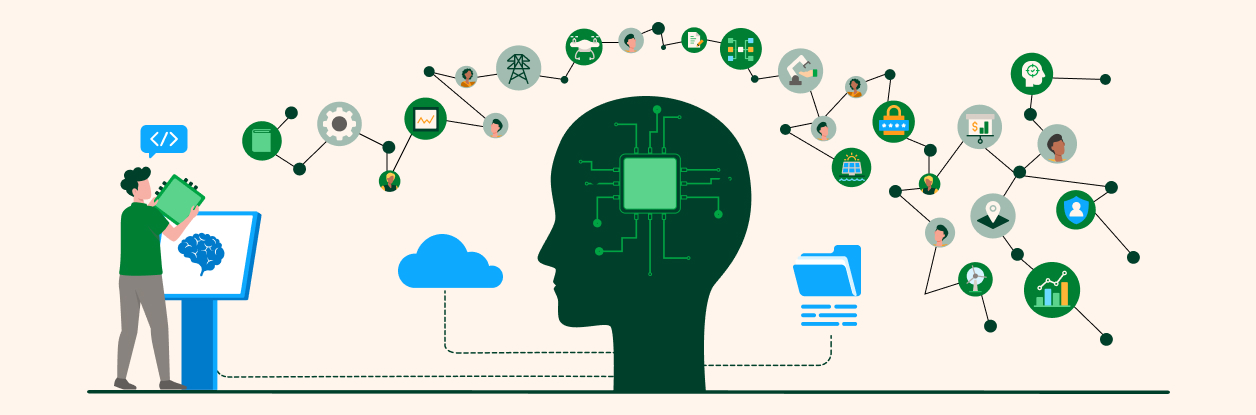
Artificial intelligence has long since left the realm of science fiction to become part of our lives, and it is set to lead a revolution comparable to that brought about by the Internet. Its applications in multiple sectors – such as health, finance, energy, transport and education, among others – have led the European Union to develop its own AI Law and its use is being regulated around the world.
Artificial Intelligence (AI) is the combination of algorithms designed to create machines that have the same capabilities as humans. The EU AI Act defines an AI system as "a machine-based system that is designed to operate with varying levels of autonomy and that can show adaptability after deployment, and that, for explicit or implicit purposes, infers from the input information it receives how to generate output results, such as predictions, content, recommendations or decisions, which may influence physical or virtual environments".
Types of Artificial Intelligence
There are different ways to classify types of artificial intelligence: based on their capabilities, their functionalities or how they act.
Computer science experts Stuart Russell and Peter Norvig differentiate between several types of artificial intelligence in their work "Artificial Intelligence: A Modern Approach":


Systems that think like humans
They automate activities such as decision-making, problem-solving and learning. One example is artificial neural networks.
Systems that act like humans
These are computers that perform tasks in a similar way to humans. Robots are an example of this.
Systems that think rationally
They attempt to emulate the rational logical thinking of humans, i.e., research is conducted into how to enable machines to perceive, reason and act accordingly. Expert systems fall into this group.
Systems that act rationally
Ideally these are systems that attempt to rationally imitate human behaviour, such as intelligent agents.


Narrow or weak AI
This is the only type that currently exists; the rest are theoretical forms of AI. It is a technology that can be trained to perform a single or limited task faster than a human mind. This category includes virtual voice assistants such as Siri or Alexa and generative AI such as ChatGPT, Sora, DALL·E and chatbots (opens in a new tab).
General AI
Unlike narrow AI, general artificial intelligence (opens in a new tab) would be capable of solving problems without specific prior programming for that task and could learn in new contexts in real time, something that only humans and some animals can do.
Super AI
This is a theoretical concept according to which artificial intelligence would be capable of thinking, reasoning, making judgements and could feel emotions, have desires, beliefs and needs of its own.


Reactive AI
This is a technology that does not store memory and only reacts to current stimuli. In other words, it cannot be trained and does not use stored knowledge to make decisions.
Self-aware AI
This type of AI is similar to Super AI and is also purely theoretical. This type of artificial intelligence would be self-aware, that is, it would understand its condition and limitations and could develop emotions, thoughts and beliefs similar to those of humans.
Limited memory AI
This technology allows information to be stored for a short period of time. Based on this information, it can recall events and results it has previously obtained to resolve the proposed action. Although it may seem like a simple and limited technology, it is currently the most common, as generative AI, virtual assistants and autonomous cars, for example, fall into this classification.
Mental and emotional AI
This type of artificial intelligence falls within the Theory of Mind, so it is a purely theoretical option at present. However, researchers explain it as a technology capable of understanding human thoughts and emotions through the analysis of images, voices and other data, and thereby responding by taking them into account and even simulating them at certain times.

Practical applications of Artificial Intelligence
AI has become a resource for everyday use. From facial recognition on mobile phones, voice assistants powered by natural language processing technology, such as Apple's Siri, Amazon's Alexa or Microsoft's Cortana, autonomous vacuum cleaners to AI in search engines or generative AI in popular applications such as ChatGPT, Perplexity, Copilot, DALL·E, Nano Banana, Gemini... All of these are part of the routines and work of millions of people around the world, and they do so with one goal in mind: to make people's lives easier.
Advances in AI are already driving the use of big data due to its ability to process vast amounts of data, learning from it through deep learning, and providing communication, commercial and business advantages that have positioned it as the essential technology of the coming decades. Transport, education, energy, health, culture… no sector will be able to resist its charms.
Applications of artificial intelligence
Artificial intelligence is already operating in virtually every sector of the economy. Beyond assistants and chatbots, which can understand speech, text and images and generate new content or automate tasks, there are sectors where its applications represent a major technological leap forward.
In healthcare, current systems analyse medical images, cross-reference clinical records and detect diseases with a level of accuracy that until recently was the exclusive domain of human specialists. In agriculture, AI platforms examine soil composition and anticipate pest outbreaks before they occur. In logistics, they calculate routes and predict equipment failures in real time.
The financial sector uses AI to detect fraud and automate decisions that previously required entire teams of analysts. Education has also been transformed: there are platforms that adapt learning pathways to each student according to how they learn, identify difficulties before they lead to academic failure and, at the same time, detect plagiarism in submitted work.
Although it is not yet widespread, there are already several projects integrating artificial intelligence into cities to create what are known as smart cities, where the aim is to improve efficiency in transport, public administration processes and security.
For an energy company, however, two applications are particularly significant. The first is the management of the business itself: the sector generates such a vast volume of operational data that AI has become an essential tool for predictive analysis, algorithmic energy trading and the optimisation of day-to-day operations. End users also benefit – they can manage and reduce their energy consumption from home – but the greatest efficiency gains occur across the production and distribution chain.
The second is the role of AI in responding to climate change. Unmanned underwater vehicles detect leaks in oil pipelines. Satellites analysed by algorithms identify emissions and changes in the Earth’s surface. Weather forecasting systems anticipate extreme events with enough lead time to enable decisions to be taken before damage becomes irreversible. Fleets of drones plant trees on an industrial scale to help offset deforestation.
What seemed like science fiction a decade ago is now part of the catalogue of real-world applications of this technology.


Trends and advances in Artificial Intelligence
Artificial intelligence has become one of the most revolutionary technologies of recent times. Its rapid adoption both at the business level and in everyday use has driven almost meteoric development, generating increasingly intelligent and refined models to support widespread demand. Starting with the original chatbots, much more powerful and specialised systems are being created, in some cases integrated into real products, which will transform businesses and private uses. Here are some key trends that will shape the future of this technology:
Specialisation
New artificial intelligence will move from high volume to high specialisation in the tasks it must perform or the field of knowledge. This will optimise the desired result.
Regulation and security requirements
As technology advances, new regulations are being established to ensure legal compliance and proper data management, especially in sensitive sectors.
Integrated AI
Artificial intelligence will no longer be used through chat-type interfaces and will be integrated into search engines, CRMs, mobile applications and other office applications in such a way that the user does not play such an active role but rather learns in a more autonomous way and acts on that information.
Specialisation
New artificial intelligence will move from high volume to high specialisation in the tasks it must perform or the field of knowledge. This will optimise the desired result.
Regulation and security requirements
As technology advances, new regulations are being established to ensure legal compliance and proper data management, especially in sensitive sectors.
Integrated AI
Artificial intelligence will no longer be used through chat-type interfaces and will be integrated into search engines, CRMs, mobile applications and other office applications in such a way that the user does not play such an active role but rather learns in a more autonomous way and acts on that information.
Iberdrola, at the forefront of Artificial Intelligence
Artificial intelligence (AI) is a technology that is already part of Iberdrola's business, and its various applications have become a fundamental resource for the company. Discover how we use AI in our activities and what its impact is on our production and our customers.
-

Commercial development with AI
Artificial intelligence systems are now a very effective way to achieve automation in purchasing or home resource management. One such solution is the Advanced Smart Assistant, a digital platform launched by Iberdrola that allows our customers to easily and automatically manage the consumption of smart electrical devices.
With this innovative product, deployed in the Amazon Web Services (AWS) cloud and developed at Iberdrola's Innovation Middle East Centre using AI services, users can also shift consumption to cheaper tariff hours, maximising electricity savings in their homes.
-

AI applied to renewable energy
Machine learning is a discipline within the field of artificial intelligence that provides any system with the ability to identify patterns through previously obtained data. These information-rich algorithms enable computers to perform specific tasks autonomously, without the need for programming.
One of the main applications of machine learning is in the field of weather forecasting, as this technique allows machines to quickly and effectively obtain repetitive data or information related to meteorological processes. A clear example of this is the MeteoFlow system, developed by Iberdrola Renovables.
This is Iberdrola's own computer system that is capable of estimating how much the Group's various renewable energy facilities will produce based on weather forecasts. Using information on wind for wind farms or solar radiation for photovoltaic plants, for example, MeteoFlow produces production forecasts that subsequently facilitate the sale of the energy produced, the maintenance of the facilities and the preparation of reports.
-

Distribution and transmission networks with AI
The integration of data analysis using artificial intelligence can significantly improve the processes and operation of smart grids. Thanks to the digitisation of the networks and the incorporation of smart meters, everything related to the operation of smart grids and energy supply can be managed quickly and remotely, enabling frequent preventive maintenance, the detection of anomalies and the anticipation of dangerous situations.


Our latest news on Artificial Intelligence




European AI Regulation: Key to the future of Artificial Intelligence
The European Artificial Intelligence Regulation is the first major global regulation that seeks to establish a common legal framework for the development, marketing and use of this technology. This pioneering regulation combines the promotion of innovation with the guarantee that artificial intelligence (AI) is applied in a safe, ethical and respectful manner regarding fundamental rights. We analyse its objectives, the risk classification it establishes, the implementation deadlines and Iberdrola's commitment to the responsible use of AI.
Learn more about the European AI Act
European AI Regulation: Key to the future of Artificial Intelligence
The European Artificial Intelligence Regulation is the first major global regulation that seeks to establish a common legal framework for the development, marketing and use of this technology. This pioneering regulation combines the promotion of innovation with the guarantee that artificial intelligence (AI) is applied in a safe, ethical and respectful manner regarding fundamental rights. We analyse its objectives, the risk classification it establishes, the implementation deadlines and Iberdrola's commitment to the responsible use of AI.
Learn more about the European AI ActCurrent laws on Artificial Intelligence
The European Union was a pioneer in developing a regulatory framework for the use of artificial intelligence, approving its AI Act in 2024. This legal framework addresses the uses and risks of this technology and seeks to protect users as its applications advance in all areas of life.
This new law establishes a series of risk-based standards for developers and implementers of artificial intelligence applications to consider when creating and improving their products. To facilitate the transition, the European Union has launched the AI Pact, a voluntary initiative to advance compliance with these new guidelines.
Elsewhere in the world regulations are also emerging to help ensure that the development of this technology is safe and inclusive for all users. In the United States there are several federal, state and agency regulations governing both the development and use of AI. For its part, China has developed several regulations focused on algorithms and generative AI to protect personal data, ensure security and properly label AI-generated content and deep fakes.
Artificial intelligence... Yes or no?
How do you imagine the world after the widespread adoption of artificial intelligence? Are you for or against? In this podcast we tell you where technology is heading and what the experts are saying about it.

Artificial intelligence and its applications in robotics are already changing the world, and although there are voices such as that of Swedish philosopher Nick Bostrom from the University of Oxford, who predicted that "there is a 90% chance that between 2075 and 2090 there will be machines as intelligent as humans", or Stephen Hawking, who ventured that machines will completely surpass humans in fewer than 100 years, the truth is that far from making us obsolete, AI will make us more efficient and allow us to perform actions that we would never have been able to do due to their complexity. Can you imagine exploring parts of the universe that are totally hostile to humans? Thanks to AI, one day it could be possible.
Articles from our guest authors


More about artificial intelligence
-
- What is Artificial Intelligence?
- What is Artificial General Intelligence (AGI)?
- Deep learning
- Evolution of Artificial Intelligence
- What is a chatbot?
- Predictive analytics
- Innovation in electricity grids
- Androids
- Privacy enhancement technologies
- Find out what is digital identity
- Distribution system operators (DSO)
- Internet of things (IoT)
- What is a virtual power plant (VPP) and how does it work?
-
- History of artificial intelligence
- Natural Language Processing
- What is machine learning
- AI Algorithms
- What are cobots?
- Artificial vision
- Hyperautomation meaning
- AI Centre of Excellence
- Artificial intelligence in electricity networks
- Green artificial intelligence
- The autonomous car
- What is a digital twin?