


History of artificial intelligence
Artificial intelligence: birth, applications and future trends
While it might sound like something from a futuristic film, artificial intelligence (AI) is a field that is deeply embedded in our everyday lives. The idea of machines capable of imitating human intelligence is more than a century old, but it has advanced significantly in recent years. Today, AI is present in many aspects of our daily lives, often without us noticing. Discover what artificial intelligence is, what it is used for, what its risks and challenges are and what we expect from it in the future.

Artificial intelligence has emerged as a revolutionary tool with applications that are increasingly present in our everyday lives. From the creation of robots with human-like capabilities to virtual assistants that respond to voice commands on mobile devices and smart speakers, AI has captured the attention of global companies in the Information and Communications Technology (ICT) sector. Considered by many to be the Fourth Technological Revolution, following the expansion of mobile platforms and cloud computing, AI is driving profound transformation. However, its development is the result of a long process of scientific and technological advances that date back several decades.
Definition and Origins of Artificial Intelligence
When we speak of "intelligence" in a technological context we often refer to the ability of a system to use available information, learn from it, make decisions and adapt to new situations. It implies an ability to solve problems efficiently, according to existing circumstances and constraints. The term "artificial" means that the intelligence in question is not inherent in living beings, but is created through the programming and design of computer systems.
As a result, the concept of "artificial intelligence" (AI) refers to the simulation of human intelligence processes by machines and software. These systems are developed to perform tasks that, if performed by humans, would require the use of intelligence, such as learning, decision-making, pattern recognition and problem solving. For example, managing huge amounts of statistical data, detecting trends and making recommendations based on them, or even carrying them out.
Today, AI is not dedicated to creating entirely new knowledge, but rather focuses on collecting, processing and analysing data to maximise efficiency in decision-making. The three fundamental pillars on which AI is based are:
-
Data. This is the information that is collected and organised so that the system can automate tasks. It can include numbers, text, images, sounds and other types of data.
-
Hardware. This refers to the computing infrastructure that enables the processing of large volumes of data quickly and accurately, allowing software to run efficiently.
-
Software. This consists of algorithms and mathematical models that train systems to recognise patterns within data, learn from them and generate results that optimise processes.
But what are AI algorithms? This is the name given to the rules that provide the instructions for the machine. The main AI algorithms are those that use logic, based on the rational principles of human thought, and those that combine logic or intuition (deep learning), which use the way people's brains work to make the machine learn as they would.
How was artificial intelligence born?
The idea of creating machines that mimic human intelligence was present even in ancient times, with myths and legends about automatons and thinking machines. However, it was not until the mid-20th century that their true potential was investigated, after the first electronic computers were developed.
In 1943 Warren McCulloch and Walter Pitts presented their model of artificial neurons, considered the first artificial intelligence, even though the term did not yet exist. Later, in 1950, the British mathematician Alan Turing published an article entitled "Computing machinery and intelligence" in the magazine Mind where he asked the question: Can machines think? He proposed an experiment that came to be known as the Turing Test, which, according to the author, would make it possible to determine whether a machine could have intelligent behaviour similar to or indistinguishable from that of a human being.
John McCarthy coined the term "artificial intelligence" in 1956 and drove the development of the first AI programming language, LISP, in the 1960s. Early AI systems were rule-centric, which led to the development of more complex systems in the 1970s and 1980s, along with a boost in funding. Now, AI is experiencing a renaissance thanks to advances in algorithms, hardware and machine learning techniques.
As early as the 1990s, advances in computing power and the availability of large amounts of data enabled researchers to evolve learning algorithms and lay the foundations for today's AI. In recent years, this technology has seen exponential growth, driven in large part by the development of deep learning, which harnesses layered artificial neural networks to process and interpret complex data structures. This development has significantly transformed various AI applications, such as image and voice recognition, natural language processing (NLP) and autonomous systems, including self-driving vehicles and drones.
History of artificial intelligence
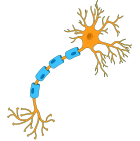
American researchers Warren McCulloch and Walter Pitts present their model of artificial neurons, considered the first artificial intelligence.

British mathematician Alan Turing proposes a test for machine intelligence. If a machine can fool humans into thinking it is human, then it has intelligence.

American computer scientist John McCarthy coins the term "artificial intelligence" to describe "the science and engineering of making machines intelligent".

General Motors installs the first industrial robot, Unimate, to replace humans in assembly tasks.

Joseph Wizenbaum develops the first natural language processing computer program, ELIZA, which simulates human conversation.

Shakey, the first general-purpose mobile robot capable of reasoning about its own actions, is launched. It is considered the forerunner of autonomous cars.

IBM's Deep Blue supercomputer beats world chess champion Garry Kasparov in one game.

Roomba, the first mass-produced robotic hoover sold by iRobot, is launched, capable of roaming and cleaning in the home.

Apple integrates Siri, a virtual assistant with a voice interface, into its iPhone 4S.

IBM's Watson system, capable of answering questions asked in natural language, wins first prize in the popular US TV quiz show Jeopardy!

The Eugene computer program passes the Turing Test by convincing a third of the judges participating in the experiment that it was a human being.

DeepMind's AlphaGo programme, based on a deep neural network, beats Lee Sodol, the world Go champion in five games.

OpenAI launches ChatGPT, an artificial intelligence chatbot application trained to hold conversations and answer questions, to the public.

AI “goes creative” (Emergence of models capable of generating text, images and video with simple prompts, marking the beginning of modern generative AI)

Mass adoption and co-pilots (Global deployment of AI-powered co-pilots (including Copilot-like systems in search engines and browsers) and transition from traditional analytical tools to generative AI models capable of increasing productivity by +34%)

Mature generative AI and multimodality (Generative AI becomes a key strategic component and the use of multimodal AI is reinforced (understanding text, voice, image and video to accelerate processes)
Key milestones in AI: in 1943, the first model of artificial neurons was created; in 1997, Deep Blue defeated the chess champion; in 2022, ChatGPT brought generative AI into human conversation; and by 2025, AI is already mature and multimodal, capable of working with text, voice, images and video.

Functions and purposes of artificial intelligence
Artificial intelligence plays a key role in digital and sustainable transformation in various sectors. Not only does it create a favourable climate for the development of an increasingly advanced digital landscape, but it is also one of the most impactful sustainable technologies: it enables organisations or companies to reduce the number of teams, resources or materials. It offers higher productivity with less, which guarantees a digital and sustainable basis for any company.
AI has practical applications in a wide variety of sectors, driving efficiency, innovation and decision making. Some of these areas are:
-

Health
AI is transforming healthcare through chatbots that collect symptoms to suggest preliminary diagnoses, improving accuracy through the use of large volumes of clinical data. It is also driving the development of personalised treatments by analysing genetic and medical data to create tailored therapies, such as in precision medicine, which adapts treatments to the individual characteristics of each patient.
-

Finance
Smart technology enables the assessment of risks and opportunities, improving investment and lending decisions as well as providing personalised financial advice through virtual assistants.
-

Education
There are educational platforms that use AI to adapt learning content according to the individual needs of students. It can also simplify administrative tasks, such as automatically marking exams.
-

Agriculture
AI analyses agricultural data to create precision agriculture by optimising resource use, improving productivity and reducing environmental impact. In addition, AI-based drones and sensors can monitor the state of crops and help in the early detection of diseases.
-

Energy
Artificial intelligence applications optimise energy distribution, improving the efficiency and reliability of power grids, and allow equipment failures to be predicted, reducing downtime and maintenance costs.
-

Logistics and transport
AI plays a key role in the development of autonomous vehicles, as well as in the optimisation of delivery and transport routes, reducing costs and emissions.
-

Commercial
Some artificial intelligence applications make it possible to predict future sales and select the most appropriate product to recommend to customers, optimising both commercial decision-making and the shopping experience.







Current uses of artificial intelligence (AI) in the energy sector
Artificial intelligence is transforming the energy sector by optimising resource management, improving efficiency and reducing costs. Some of the main current uses of AI include:
- Demand forecasting: AI makes it possible to anticipate patterns in energy consumption, adjusting production and distribution more precisely.
- AI for asset management: It facilitates the monitoring and maintenance of assets, optimising their lifespan and reducing operating costs through predictive analysis.
- AI for efficiency in smart grids: AI optimises the flow of energy in smart grids, minimising losses and improving service quality for users.
- Use of advanced analytics in networks: This enables in-depth real-time data analysis to improve the management of electrical networks, anticipating potential failures and improving service reliability.
- Predictive renewable models (wind and solar): AI uses meteorological and generation data to predict energy production from renewable sources, allowing them to be integrated more efficiently into the network.
- Predictive maintenance: Through predictive algorithms, AI can identify potential failures in equipment and systems, enabling preventive maintenance that reduces downtime and costs.
Risks and challenges associated with artificial intelligence
Advances in artificial intelligence have led to the transformation of various areas and sectors, but have also raised concerns about possible risks or challenges that may arise in its development. Here are some examples:
-

Biases and algorithmic discrimination
AI relies on algorithms and data to make decisions, but these can be biased and perpetuate injustices. They can reflect and amplify existing biases, which could lead to discriminatory decisions.
-

Violation of privacy
The collection and analysis of large amounts of data to feed AI algorithms can raise concerns about the privacy of people's information if not handled properly. Data breaches may even encourage the proliferation of potential cyber attacks.
-

Labour displacement
AI and automation may also risk displacing millions of workers from their jobs. Repetitive and routine tasks can easily be taken over by advanced AI systems, which could lead to mass unemployment in some sectors, posing economic and social challenges.
-

Security
AI can also be used for malicious purposes, such as for the development of more sophisticated cyber attacks that are less familiar to victims.
-

Ethics and legal responsibility
Algorithm-driven decisions can raise ethical questions, especially when dealing with critical situations such as healthcare, justice and security. This is compounded by the difficulty of determining legal liability in case of incorrect decisions or detrimental actions of AI systems.
-

Superintelligence and control
Some experts have raised concerns about a possible risk associated with the development of super-intelligent AI in the long term. The main fear is that if we were to create an AI with higher-than-human intelligence, it could become autonomous and surpass our ability to control it.
-

Energy consumption
AI models, particularly the most complex ones, require a large amount of computing power to be trained and operated. This translates into high energy consumption, which can contribute to the carbon footprint, particularly if data centres do not use renewable energy sources.


Looking to the future: trends and projections for AI
The ethics of AI will remain a central concern, focusing on ensuring that systems are fair, equitable and respect users’ privacy. In this context, explainable AI (XAI) is becoming increasingly important to improve transparency and trust in automated systems.
As AI evolves, it is becoming increasingly specialised in areas such as personalised healthcare, with treatments tailored to individual needs based on genetic data, and education, where more inclusive and adaptive learning tools will be developed.
The convergence of AI with emerging technologies such as quantum computing, which promises to improve the speed and capacity of data processing, and advanced robotics, will enable the development of more effective autonomous systems in areas such as logistics and healthcare. What’s more, generative artificial intelligence, which includes tools such as advanced language models, is beginning to revolutionise sectors such as content creation, programming and creative design.
As artificial intelligence continues to expand, it is essential to establish global regulatory frameworks to ensure its ethical and responsible use, protecting both consumers and companies. AI must be integrated in a way that maximises its benefits and minimises its risks, particularly in terms of privacy, algorithmic bias and sustainability.