What is nuclear energy?
How nuclear energy works and its advantages
Nuclear energy is considered a clean energy source and is a very efficient way of producing electricity. Contained in the nucleus of the atom, it can be obtained through fission or fusion reactions, offering numerous and diverse applications.
Nuclear energy is the energy contained in the nucleus of an atom, which holds together the protons and neutrons that compose it. Atoms – the smallest particles into which a chemical element can be divided without losing its properties – can release this energy in two ways: through fission or fusion of their nucleus.
When either of these two reactions (nuclear fission or nuclear fusion) occurs, the nuclei of the atoms experience a slight loss of mass, which is converted into an enormous amount of heat energy. This is an extremely powerful source of energy, much more powerful than the chemical energy stored in the bonds between atoms of molecules of the same chemical element.
How is nuclear energy generated?
To obtain energy through nuclear fission, a neutron collides with the nucleus of a fissionable atom, fragmenting it into smaller nuclei and releasing a huge amount of energy. Nuclear power plants use the energy produced in the fission process to generate electricity, typically using uranium as fuel.
When a first neutron collides with the nucleus of a uranium atom it will release other neutrons during fission, which in turn will collide with other neighbouring atoms. This multiplier effect is known as a nuclear chain reaction. Each time this reaction occurs, energy is released in the form of heat and radiation. A nuclear reactor can initiate, maintain and stop chain fission reactions in a controlled manner, using the appropriate means to extract the heat generated during these reactions.
In nuclear fusion, meanwhile, the nuclei of two light atoms combine or fuse together, forming a more stable and heavier nucleus. This reaction occurs naturally in the Sun, for example, and it is thanks to the constant fusion of hydrogen atoms to form helium atoms that so much energy is released, reaching the Earth in the form of light and heat.
In practice, scientists have not yet produced a controlled chain reaction to generate energy from nuclear fusion, which is one of the great challenges of scientific research in this field. However there is growing interest among large companies in this energy source, as demonstrated by Google's pioneering multi-million dollar agreement with start-up CFS
External link, opens in new window. to purchase 200 MW of nuclear fusion energy from its first commercial fusion plant in Virginia (United States).
Advantages of nuclear energy
Nuclear energy has many advantages that make it attractive as an energy source. Some of the most notable are:
What is a nuclear power plant and how does it work?
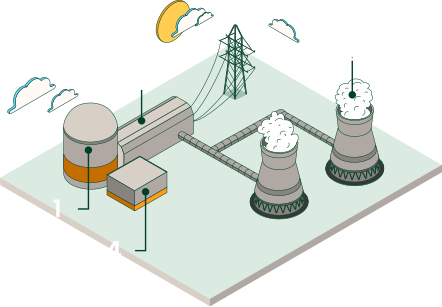
A nuclear power plant is an industrial facility that uses nuclear energy to generate electricity. The operation of a nuclear power plant follows a process similar to that of a conventional thermal power plant, in which thermal energy is obtained by burning fossil fuels. However, in a nuclear reactor it is obtained through chain reactions of nuclear fission of uranium atoms, a process that does not emit greenhouse gases into the atmosphere.
The thermal energy released is used to heat water until it turns into steam at high pressure and temperature. Here we can differentiate between two types of reactors: boiling water reactors (BWR) and pressurised water reactors (PWR). In BWRs the water is converted into steam directly inside the reactor while in PWRs the hot water from the reactor is transferred to a secondary circuit to generate steam.
This steam turns a turbine connected to a generator, which transforms the mechanical energy of the turbine's rotation into electrical energy.
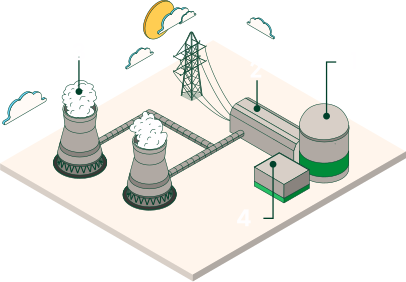
The process that takes place in a nuclear power plant can be summarised in four steps:
Like any industrial activity, the operation of nuclear power plants generates waste that must be properly managed and treated. In this case, radioactive waste and spent fuel. Technicians have technically resolved the management of radioactive waste, treating it in a fully controlled manner and without risk to the public. In the case of Spain, the Seventh General Plan for Radioactive Waste defines how to treat waste and decommission power plants in a safe and orderly manner. What’s more, Spain has one of the most modern storage facilities in the world for low- and medium-level waste, El Cabril, as well as temporary storage facilities at the power plants themselves for spent fuel until its final disposal in a deep geological repository, such as the one already in existence in Finland.
Main elements of a nuclear power plant
The key components of nuclear power plants are as follows:
- Nuclear reactor: It has systems that allow the fission reaction and energy generation to be started, maintained and stopped in a controlled manner.
- Reactor vessel: This is the heart of the nuclear reactor, containing the nuclear fuel (usually uranium) and the coolant (usually water).
- Turbine and generator: These convert thermal energy or heat into mechanical energy and then into electrical energy.
- Cooling systems: These allow the plant to evacuate the heat it generates and condense the main steam.


Is nuclear energy considered clean energy?
The IPCC (the global scientific authority on climate change) ranks nuclear energy among the technologies with the lowest carbon emissions throughout their life cycle, comparable to wind power and lower than most renewables. It does not emit greenhouse gases or other combustion products into the atmosphere, making it an important technological option in climate change mitigation strategies, depending on each country's energy strategy.
In 2022 the European Union included nuclear energy in its green taxonomy, subject to a series of requirements, as it considers that there is clear and abundant evidence of the potential of nuclear power generation to contribute substantially to climate change objectives and facilitate the development of intermittent renewable energy sources. In fact, the European Commission has shown support for nuclear energy as part of the energy transition, urging Member States to consider new investments in this sector and to extend the operational life of existing nuclear plants.
During COP28, held in Dubai in 2023, nuclear energy reached another historic milestone when it was included for the first time among the low-emissions technologies whose deployment the 198 signatory countries called to accelerate in order to help achieve deep and rapid decarbonisation, particularly in hard-to-abate sectors such as industry.
Other international actors such as the International Energy Agency (IEA), the United Nations (UN) and the Intergovernmental Panel on Climate Change (IPCC) recognise the role of nuclear energy in decarbonisation and consider it key to achieving global climate goals for climate change mitigation.
Recently, a cross-sector group of large energy consumers, including major technology companies such as Amazon, Meta and Google, signed a commitment
External link, opens in new window. in support of the goal of at least tripling global nuclear capacity by 2050, endorsed by more than 20 countries at COP28. This is the first time that large companies, beyond the nuclear sector, have come together to publicly endorse an expansion of nuclear energy to meet growing global energy demand.
Current uses of nuclear energy
Currently, nuclear energy provides approximately 10% of the world's electricity, making it the second largest source of energy globally after hydroelectric power. It is also a key option for many nations in the transition to a cleaner and more stable energy system, allowing for greater energy independence in the current geopolitical context.
According to the World Energy Outlook 2025, the International Energy Agency (IEA) states that nuclear energy is experiencing a strong global resurgence, taking into account support for the extension of the useful life of nuclear reactors in most countries, such as Japan, Korea, Canada, France and the United States, as well as for new constructions included in the national energy strategy plans of many countries such as the United Kingdom, Poland, France, the United States and Canada.
In 2024, world leaders gathered at the first ever Nuclear Energy Summit, organised by the International Atomic Energy Agency (IAEA)
External link, opens in new window. and held in Brussels, to highlight the role of this energy source in addressing global challenges such as reducing fossil fuel use, improving energy security and self-sufficiency and boosting economic development
Other uses of nuclear technology
Nuclear technology has many applications that are fundamental to our daily lives. While the best known are medicine and electricity production in nuclear power plants, there are many others in fields as diverse as agriculture, industry and art. Here are some of the most interesting uses:
The future of nuclear energy
Nuclear energy can play a crucial role in reducing carbon emissions, helping to combat climate change and meet growing global energy demand while also facilitating the worldwide deployment of renewable energies.
In terms of future prospects and technological advances, developers are currently building small modular reactor (SMR) prototypes, most of which are advanced fission designs. These reactors, which are more compact than conventional ones, seek to make nuclear energy more competitive and accessible through various applications beyond electricity generation, ensuring network stability and optimal integration into systems with high penetration of intermittent renewable energies.
Some of them feature very high-temperature steam production – key for non-electrical uses such as hydrogen generation or chemical processes – intrinsic safety and greater sustainability thanks to the possibility in some designs of reusing radioactive waste in the fission process itself.
At the same time, important research continues to be carried out in nuclear fusion, with the aim of developing a clean, safe and virtually inexhaustible source of energy.
More about nuclear energy


