Lighting projects in Brazil
We illuminate Brazil's artistic and cultural heritage
At Iberdrola, we are carrying out various lighting projects in Brazil with the aim of promoting local development and sustainable tourism. Through the Neoenergia Institute – the foundation set up by our subsidiary in Brazil – we have helped to improve the lighting of the country's historic and iconic buildings.

The lighting of these spaces goes beyond simply showcasing their architecture: it becomes a tool for bringing heritage closer to the public, strengthening the cultural identity of communities and creating new points of interest for visitors and tourists. Through these projects, Iberdrola and the Neoenergia Institute are helping to preserve and revitalise Brazil's heritage, combining culture, innovation and sustainability.
La iluminación como impulso a la cultura brasileña
Through our lighting projects, the Iberdrola Group is helping to promote Brazilian culture and heritage in various ways
-

Showcasing heritage
Lighting allows us to highlight the architecture and unique features of historic buildings and iconic spaces, reinforcing their cultural value and recognition.
-

Bringing culture closer to the public
Carefully designed lighting transforms these places into more attractive and accessible spaces, encouraging the public to enjoy them and feel a connection to them.
-

Strengthening local identity
Illuminating buildings and spaces that are representative of each region helps to preserve its heritage and highlight those elements that form part of its identity.
-

Bringing culture and innovation together
These projects combine heritage with new lighting solutions to create contemporary visual experiences whilst remaining true to the historical and artistic character of the spaces.
-

Creating spaces for culture
Lighting can transform iconic buildings and landmarks into venues for celebrations and cultural activities, helping to integrate them into city life.


Celebrating 125 years of history with lighting projects
At the Iberdrola Group, we celebrated 125 light-years, a milestone in the long journey that has made us the largest electricity company in Europe and one of the two largest in the world by market capitalisation. To mark the occasion, we launched an extensive programme of activities that included various lighting initiatives for historic and iconic buildings and sites.
Iberdrola's lighting projects in Brazil
These are some of the main projects through which Iberdrola, via the Neoenergia Institute, is helping to showcase Brazil's heritage and culture through lighting:
Museo Histórico Lauro da Escóssia in Mossoró (Rio Grande do Norte)
Project date: 2025
On 1 November 2025, the Neoenergia Institute's Cultural Lighting Programme reached the Lauro da Escóssia Historical Museum in Mossoró (Rio Grande do Norte), a key venue for preserving the city's history. The current building opened in 1880 as the former Public Prison and Town Council Chamber and became a museum in 1981. It now houses a valuable collection of artefacts, documents and photographs relating to prehistory, palaeontology and local history.
The project, spearheaded by the Neoenergia Institute, upgraded the external lighting by installing floodlights fitted with more efficient bulbs, capable of highlighting the architectural features of the façade and generating energy savings of up to 70%. The project also included heritage and environmental education initiatives involving more than 300 pupils and teachers from local schools, strengthening the link between heritage conservation, education and the local region.


Convento de Nossa Senhora da Conceição en Itanhaém (São Paulo)
Project date: 2024
On 10 December 2024, the Neoenergia Institute inaugurated the new eco-efficient lighting of the Nossa Senhora da Conceição Convent in Itanhaém. This building, built 492 years ago, located in the historic centre of the municipality of Itanhaém in São Paulo, is the seventh historic building in the Neoenergía Institute's Cultural Lighting Programme.
The Convent was lit up with its new lights consisting of energy-efficient, high-performance LED floodlights that not only enhances the beauty of the building's architecture but can also generate savings of up to 60% on electricity.
This project by the Neoenergia Institute’s Cultural Lighting Programme was made possible thanks to partnerships with the City of Itanhaém, the Diocese of Santos, Brasilis Produções Culturais and Neoluz, which contribute to improving Brazil's historic lighting.
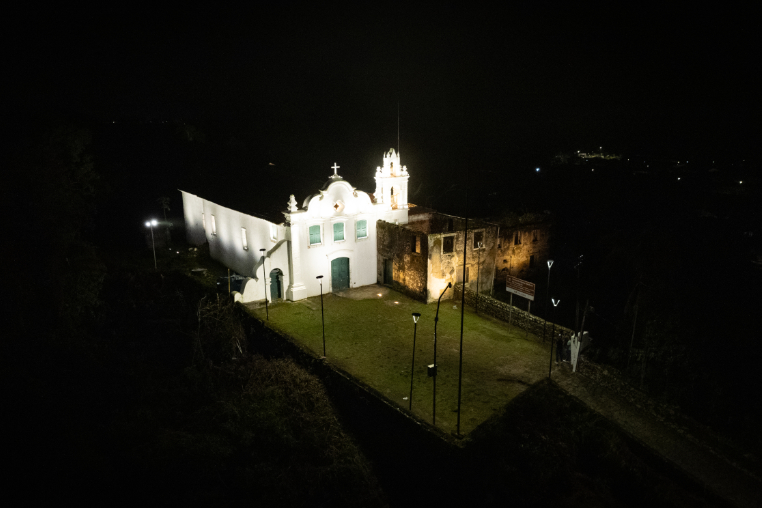
Lighting at the Convent of Nossa Senhora da Conceição in Itanhaém (Brazilian Portuguese version).
Church of Nossa Senhora Santana in Rio de Contas (Chapada Diamantina, Bahia)
Project date: 2023
In 2023, the Neoenergia Institute's Cultural Lighting Programme arrived in Rio de Contas, in the Chapada Diamantina region (Bahia), to showcase the Church of Senhora Santana, one of the town's landmarks. Built of stone and listed by the National Institute of Historical and Artistic Heritage (IPHAN), the church forms part of the town's architectural ensemble and is considered one of its key heritage landmarks.
The project involved the installation of new LED floodlights, a more efficient solution that highlights the architectural features of the façade whilst reducing energy consumption by up to 60%. The initiative was complemented by heritage education activities aimed at pupils from local schools and a cultural opening event, thereby strengthening the link between heritage conservation, culture and the involvement of the local community.
Theatro Cinema Guarany (Pernambuco)
Project date: 2022
The Theatro Cinema Guarany, located in Triunfo, Pernambuco, is one of the state's leading venues for the performing and audiovisual arts. Opened in 1922, the building celebrated its centenary with a new cultural lighting scheme spearheaded by the Neoenergia Institute.
The new lighting scheme, unveiled on 1 December 2022, was designed to highlight the theatre's architecture and restore this iconic city building to its rightful place in the spotlight. The project was accompanied by a heritage education programme involving nearly 400 pupils from 14 state schools as well as cultural activities open to the community including a screening of films made by the pupils themselves and performances by local artists. In this way, the initiative brought together heritage restoration with public participation and the promotion of local culture.
Câmara Cascudo Memorial (Natal)
In February 2020, the Neoenergia Institute delivered the new cultural lighting for the Câmara Cascudo Memorial in the historic centre of Natal (Rio Grande do Norte). It comprises 53 spotlights fitted with LED lamps that illuminate the statue of Luís da Câmara Cascudo, Brazil's greatest folklorist, and the building's façade. This was a fully automated system that switches the lights on and off using sensors, in accordance with the region's natural light levels. This, combined with the LED lamps, reduced the building's energy consumption by 65 % compared with the traditional system.
The initiative, which was carried out in collaboration with the José Augusto Foundation, was part of a program to improve the historical, artistic and cultural heritage of historic buildings in the states where Neoenergia*, Iberdrola's subsidiary in Brazil, operates.


Fortress of Santo Amaro da Barra Grande (Guarujá)
In April 2019, Instituto Neoenergia inaugurated the new lighting for the Fortress of Santo Amaro da Barra Grande, a National Historical Heritage Site in Guarujá (São Paulo). This is the only Spanish fort in Brazil. It was built in 1584 during the Iberian Union and also houses the city's first historical museum. It is a candidate for the title of UNESCO World Heritage Site.
The project involved the replacement of the entire existing electrical and lighting systems with new ones, which are 25 % more efficient. The entire interior has been brought to life by lighting up previously unlit spaces and supplying electricity to them. New lighting points were added to the exterior lighting to point up the ramparts of the fortress.
It is calculated that the new equipment will last 20 times longer than conventional lighting.


Fort of São Tiago das Cinco Pontas (Recife)
Project date: 2018
The Fort of São Tiago das Cinco Pontas is one of the most important monuments of Brazil's colonial heritage. Built in 1630 during the Dutch occupation of what are now Recife and Olinda, it houses the Recife City Museum, with photographs, maps and archaeological fragments showing the history of Recife's urban development since the 17th century. It is currently competing with 18 other Brazilian forts for the status of UNESCO World Heritage Site.
In 2018, Instituto Neoenergia, in collaboration with the Recife city council, installed a a new LED lighting system on the ramparts of the fort, the scene of battles between the Portuguese and Dutch, which saves over 30 % of the power needed by the previous system. The façade is now lit by 66 light projectors which can change colour for different commemorative and social events.


Cruz de Cabrália (Santa Cruz Cabrália, Bahia)
Project date: 2016
In 2016 the scenic Cross of Cabrália was lit, a national symbol located on the islet of Coroa Vermelha, in the municipality of Santa Cruz Cabrália (Bahia). Here, the first mass in Brazil was celebrated on 26 April 1500 by Friar Henrique Soares.