


What are microplastics?
The source of microplastics, where they are found, and the dangers they pose
Since plastic was first introduced in the 1950s, more than 400 million tonnes of plastic have been produced every year, less than 10% of which has been recycled, according to the United Nations Environment Programme (UNEP). Tragically, the planet has become a dumping ground for this debris, which includes everything from bottles and bags, to microplastics. These tiny particles of plastics have been found in the most unexpected places, from the peak of Mount Everest to the deepest trenches of the sea, and even in the breath of dolphins.

Microplastics make their way into farmland due to sewage sludge used as a fertilizer, and then end up in waterways thanks to runoff from the top level of soil
Microplastics have become one of the greatest environmental challenges of our time due to their increasingly widespread presence in both terrestrial and aquatic ecosystems. Their tiny size and persistence in the environment make them difficult to remove and pose significant challenges for biodiversity conservation and the protection of human health. But what exactly are microplastics, and what do we know about the consequences of the pollution they cause?
What are microplastics and where do they come from?
Microplastics are defined as particles of plastics that range from just one micrometer across, which is around 1/100th the width of a human hair, to as big as five millimetres. They are either manufactured for a specific use, such as microbeads used as exfoliants in beauty products or toothpastes, or they come from large pieces of plastic that have broken down from items such as bottles or tires.
Main sources of microplastics
Microplastics originate from a variety of sources linked to human activity. The primary source is the breakdown of plastic waste, which degrades through exposure to sunlight, wind and water. Other major sources include tyre wear during driving, the release of synthetic textile fibres during washing, the deterioration of paints and coatings, the use of cosmetics and other products containing intentionally added microplastics, and the accidental loss of industrial plastic pellets used as raw material in plastic manufacturing. Together, these processes contribute to the widespread presence of microplastics in the environment.
Where do microplastics come from?
- Personal care products 57Kt
- Plastic pellets 254Kt
- Tyres 973Kt
- Synthetic textiles 211Kt
- Paint 1,301Kt
- Macro plastic (to become microplastic) 7,568Kt
- Leakage by source in Kt
- 0
- 2,000
- 8,000
Source: The Conversation

Where microplastics are found?
Microplastics have spread to virtually every ecosystem, making them a global environmental pollutant.
-

Accumulation in seas and oceans
According to the UNEP, plastic waste – including large debris and microplastics – is continuously accumulating in marine environments, posing major threats to ecosystems. Microplastics make their way into farmland due to sewage sludge used as a fertilizer, and then end up in waterways thanks to runoff from the top level of soil. They are small enough to be carried by the wind, and have been discovered in foods including honey, tea and sugar, as well as fruit and vegetables.
-

Impact on freshwater ecosystems
A study carried out by an interdisciplinary team from Penn State University found that the presence of microplastics in freshwater environments has been steadily rising for decades, and that there is a direct link between this growth and the increase in plastic production since the 1950s. The same researchers were surprised, however, to discover that they could find no link between high levels of microplastics found in the environment and population density, suggesting that they are now ubiquitous across the globe.
-

Presence in remote environments
Famously, microplastics have been found in far-flung places such as the peak at Mount Everest and in the deepest trenches of the sea. In the oceans, the largest accumulation of plastic pollution is known as the "Great Pacific Garbage Patch", and is located in waters off California. Covering an area roughly three times the size of France, the plastic waste churns in constantly moving currents. Some of it is identifiable as parts of tires or fishing nets, but most of it is microplastics. What’s more, a study published by a team of US researchers in 2024 in the scientific journal Plos One found microplastics in the breath of dolphins, indicating that these marine mammals may be inhaling the particles when they come up for air.


How humans and animals ingest microplastics?
Scientists and researchers have found widespread evidence that microplastics are ending up in human bodies, as well those of animals. A university investigation carried out in 2017 analysed 12 brands of beer that used water drawn from the Great Lakes in North America. All of the samples they examined contained small particles of plastic – particles that will be ingested by anyone who drinks that beer.
Researchers at Penn State determined that the typical American ingests more than 5,800 plastic particles every year from their intake of water, beer and sea salt alone. However, humans are exposed to microplastics not only through ingestion, but also by inhaling them and through direct contact. According to research carried out by Pennsylvania State University, microplastic fibres –such as those associated with polymers used in clothing (for example, fleece)– are more likely to adhere to or become entangled in the body due to their elongated shape.
In recent years, researchers in Austria have detected polymer particles measuring less than five millimetres in stool samples from people in eight different countries. Similarly, studies carried out in California and the Netherlands have found microplastics in lungs, blood, hair and nails.
As a result, we are living with microplastics inside our own bodies. The study “Bioaccumulation of microplastics in decedent human brains” Enlace externo, se abre en ventana nueva. (2025), published in Nature Medicine, found that the human brain contains higher concentrations of polyethylene than the liver or kidneys.
Animals are not spared from this form of pollution. Microplastics have already been discovered inside more than 1,300 animal species, according to The Conversation, including fish, mammals, birds and insects. Many animals think that the particles are food and ingest them, which can cause them damage such as blocked intestinal tracts. Animals are also harmed when the plastics inside them release the chemicals that they contain, or other compounds that they are carrying.
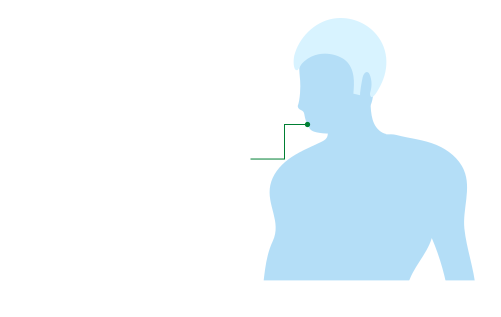
How microplastics enter the body




Inhalation
Microplastics can become airborne from the wear and tear of plastic items and synthetic textiles, leading to inhalation.
Dietary intake
Microplastics are found in seafood, salt, beer, honey, and both tap and bottled water, among other food and beverage products.
Dermal absorption
Microplastics are present in various consumer products, including cosmetics and personal care items, leading to potential ingestion or skin contact.
Source: The Conversation
The health risks of microplastics
What do we know?
Scientists have no doubt that microplastics end up in our bodies. They have been detected in human samples, including blood and even brain tissue. These findings confirm that exposure is occurring and that these particles can enter the human body.
What is being investigated?
Although the presence of microplastics in the human body has been confirmed, their effects on human health are not yet fully understood. Current research is focused on understanding how they enter the body, whether they accumulate in specific organs and what their potential short- and long-term effects may be. What’s more, the World Economic Forum has highlighted studies suggesting a possible link between exposure to microplastics and an increased risk of heart attacks, strokes and even death. However, these potential associations remain under investigation and require further scientific evidence.
What do we still not know?
At present, there are few definitive conclusions or evidence-based warnings about the impact of microplastics on human health. It is still unclear what levels of exposure should be considered harmful, whether there is a direct causal relationship between microplastics and certain diseases, or what the actual risk is for the general population.
Despite these uncertainties, public and scientific interest in the issue has grown rapidly in recent years. In Europe, this trend is reflected in the European Food Safety Authority Special Eurobarometer on Food Safety (2025)External link, opens in new window. , which found that nearly three-quarters of Europeans (73%) have heard about microplastics in food – an increase of eight percentage points since 2022 – and one-third of respondents (33%) consider them one of their main food safety concerns.
Is the presence of microplastics rising?
The researchers from Penn State who investigated microplastics found that their presence in the environment rose each decade until 2010, but then actually fell between 2010 and 2020. The team said that this warranted further study, but researchers have suggested that the fall could be down to an increase in plastic recycling. Figures from the US Environmental Protection Agency (EPA) appear to back this up, with the amount of recycled plastic just 0.3% of the total in 1980, but rising to nearly 8% in 2010.
The United Nations Environment Programme (UNEP) has a stark warning though: as well as the 19 to 23 million tonnes of plastic waste that it estimates currently leak into aquatic ecosystems every year, it forecasts that these emissions into lakes, rivers and seas will nearly triple by 2040 if no meaningful action is taken.
In fact, the report “Breaking the Plastic Wave 2025”, published by The Pew Charitable Trusts, projects that microplastic pollution will increase by more than 50% by 2040 and will account for 79% of all plastic pollution in high-income economies.



What can be done to combat microplastics?
What can I do as a consumer to reduce microplastic pollution?
Consumers can take a number of steps to reduce both the amount of microplastics they are exposed to and the quantity they release into the environment. Some recommendations include:
-

Reduce single-use plastics
Minimising the use of single-use plastics helps reduce the amount of plastic that can break down into microplastics.
-

Reuse shopping bags
Reuse shopping bags and avoid buying new plastic bags each time you go shopping.
-

Choose reusable bottles and containers
Replace bottled water with a reusable bottle, preferably made of stainless steel, and store snacks and food in reusable containers instead of single-use plastic packaging.
-

Choose natural fabrics whenever possible
Opt for clothing made from natural fibres rather than synthetic ones, and use a microfibre filter when washing clothes.
-

Wash synthetic clothing using short, cold cycles and a microfibre filter
Short, cold wash cycles reduce the amount of mechanical friction and therefore the number of microfibres released compared with long, hot cycles. Microfibre filters help capture these particles before they enter the wastewater system.
-

Avoid cosmetics containing intentionally added microplastics
Microplastics can be found in products such as exfoliants, creams, make-up and sunscreens. Choosing products that do not contain these ingredients helps prevent their release into the environment.
-

Separate and recycle waste correctly
Separate plastic packaging from other waste and place it in the appropriate recycling bin, ensuring it is empty, clean and dry. This helps reduce plastic pollution and limits the formation of microplastics.
-

Do not flush wet wipes, cigarette butts or plastic waste down the toilet or discard them in the environment
These types of waste pollute rivers and oceans and can cause serious damage to wastewater treatment and sewerage systems.


What are governments and the scientific community doing to reduce microplastic pollution?
Meanwhile, scientists and researchers are investigating methods to collect microplastics, including a tiny robot fish that has been developed at Sichuan University that can collect the particles. Another technique being developed uses vegetable oil, iron oxide and magnets, and has been found to be 87% effective at extracting microplastics from water.
Scientists in China have resorted to a biodegradable sponge made up of squid bones and cotton to remove microplastics, according to a study published in Science Advances. They used the special sponge in four different samples – pond water, irrigation water, lake water and sea water – and found that it removed up to 99.9% of microplastics.
Governments are also taking action. A number of countries have already banned microplastics in cosmetics, while France has mandated the installation of filters in washing machines to intercept microfibers, according to a study published in Science magazine. There are also multinational policies, such as the European Union’s Marine Strategy Framework Directive, which was put in place to protect the marine ecosystem and biodiversity, and its REACH (Registration, Evaluation, Authorisation and Restriction of Chemicals) legislation, which addresses the production and use of chemical substances and their potential impacts on the environment.
The same study, however, warns that there is a potential for future wide-scale environmental harm from microplastics if no decisive action is taken.