Corporate Environmental Footprint (CEF)
Iberdrola, first organisation to receive the AENOR certificate for our Environmental Footprint
Corporate social responsibility Renewable energy
True to our commitment to transparency, every year we publish our Ecological Footprint (CEF), a summary of the Group's environmental performance. External and independent verification by AENOR accredits that we have calculated and identified all the environmental impacts derived from our activities in all the countries in which we are present, with the aim of improving and reducing them.

The Corporate Environmental Footprint (CEF) is defined as a multi-criteria measure of the environmental performance of an organisation that provides goods or services, with the perspective of the whole life cycle, i.e. considering not only direct impacts but also indirect impacts on which we have influence, for example through our suppliers. The overall objective of an CEF is to seek to reduce the environmental impact derived from the organisation's activities.
Objectives of the Corporate Environmental Footprint
 Analysis life cycle Identify impacts
Prioritise aspects
 Single indicator Single methodology
Measure to improve
 TransparencyCommunication with Stakeholders Benchmarking
The Iberdrola Group's Environmental Footprint objectives are:
- Understand and compare objectively the effect of our activity in the different environmental impact categories, trace their cause, identifying the environmental aspects and the assets/technologies/regions responsible of them. This will be an extra element of information for the company's management system.
- Have a single homogeneous methodology for the whole Group that measure to improve. Development of environmental impact reduction activities to increase operational efficiency and corporate reputation, through transparency; drive innovation and internal and external benchmarking; and mitigate environmental risks.
- Ensure the Group's commitment to transparency.
Main environmental impacts observed
-

Terrestrial acidification
-

Particulate matter formation
-

Water use
-

Climate change
-

Photochemical ozone formation
-

Human toxicity
-
Ionising radiation
-

Transformation of rural land
-

Use of natural resources
-

Eutrophication: freshwater and seawater
-

Urban and rural land occupancy
-

Use of fossil fuels
-

Destruction of the ozone layer
-

Ecotoxicity: soil, freshwater and seawater
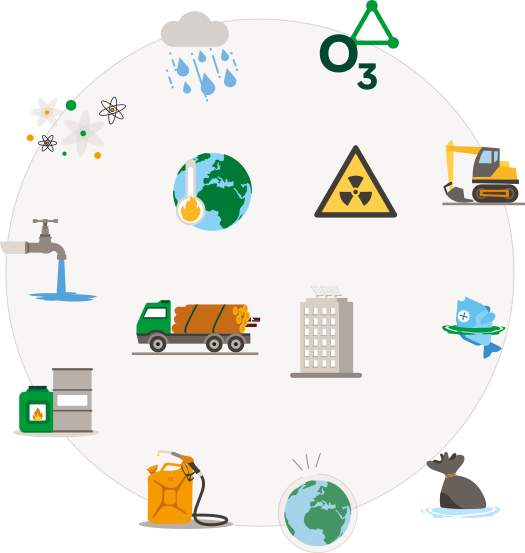
 SEE INFOGRAPHIC: Main environmental impacts observed [PDF]
The calculation of the Endpoint provides us with a final value for the company's global environmental performance by grouping the different environmental impacts into a single score. In turn, the Endpoint score values for each impact category are also reported:
| Impact category | Score (Points) |
|---|---|
| Climate change (Human health) | 1,255,434,494 |
| Destruction of the ozone layer | 465,458 |
| Human toxicity | 111,308,628 |
| Photochemical ozone formation | 7,896,765 |
| Particulate matter formation | 1,017,754,727 |
| Ionising radiation | 273,288 |
| Water comsumption (Human health) | 18,505,001 |
| Climate change (Ecosystems) | 61,418,143 |
| Terrestrial acidification | 11,280,772 |
| Freshwater eutrophication | 407,797 |
| Terrestrial ecotoxicity | 840,545 |
| Freshwater ecotoxicity | 6,311 |
| Marine eutrophication | 682 |
| Marine ecotoxicity | 6,265 |
| Water comsumption (Ecosystems) | 2,028,539 |
| Land use | 51,711,649 |
| Mineral resource depletion | 647,336 |
| Fossil fuel depletion | 59,471,881 |
| Iberdrola Group environmental footprint | 2,599,458,283 |
Data at the end of 2025. Information extracted from the "Environmental Footprint Report 2025".
Previous Corporate Environmental Footprint reports
We compiled the inventory of previous years' Corporate Environmental Footprint reports, a comprehensive document published annually in which we identify all the environmental impacts arising from our activities.