


International Women's Day 2026
We promote equal opportunities
“Rights. Justice. Action. For all women and girls.” This is the theme that was chosen by the United Nations to mark International Women’s Day. At the Iberdrola Group, we are committed to promoting the presence of women in careers related to science, technology, engineering and mathematics.
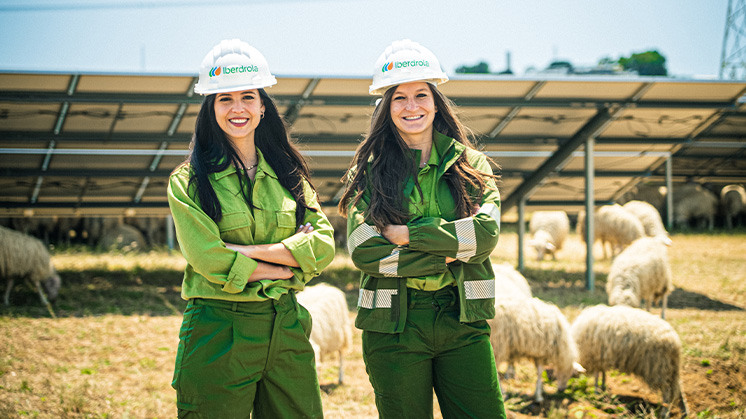
"Rights. Justice. Action. For all Women and Girls" is the slogan chosen by the United Nations to commemorate International Women's Day. The Iberdrola Group is committed to promoting the presence of women in careers related to science, technology, engineering and mathematics. From Spain to Australia, these are some of the company's female employees who contribute to driving the electrification and business development from positions related to digital transformation and innovation.
Our initiatives around the world
The Iberdrola Group is promoting initiatives worldwide to give women a voice, highlight their achievements and encourage more women to dream big. Here are some of them.
At ScottishPower (our subsidiary in the United Kingdom), we created the "Connected Women” platform. It’s a space where women in our company can meet regularly to share experiences, access an ongoing support network and benefit from a range of protocols.
At Avangrid (our subsidiary in the United States), our strong commitment to promoting and fostering an inclusive and equitable business environment has earned us a place on the Forbes 2025 list of Best Employers for Women in the United States. This recognition reflects the social and business impact our professionals generate in the sector.
At Iberdrola Italy, we understand that engineering, technology and innovation can only thrive in an environment where every individual can fully express their talent and grow professionally. Likewise, at Iberdrola Germany, to mark this special day, we chose to share stories of personal and professional achievement from the women who are part of the company. Through this initiative, we aim for every voice to be heard and to resonate with every girl or woman striving to fulfil her dreams.
In the first person:



With women in sport


You may also be interested in




All the information about
International Women's Day
What is International Women's Day and why is it celebrated?


International Women's Day is a day of action aimed at reflecting upon the successes achieved with respect to gender equality and advocating more changes and possible improvements. Furthermore, it is an especially important day for remembering women who have played leading roles throughout history.
How is International Women's Day celebrated?
International Women's Day is celebrated in many countries around the world and in some it is a national holiday. Rallies and demonstrations are held to demand gender equality and the rights of women and girls around the world. The first international women's strike was held in 2017, called by feminist organisations from more than 50 countries to make male violence visible in all its forms (sexual, social, cultural, political and economic). Since then, strikes and general strikes have been held in which women are called to participate in a way that goes beyond merely work-related (care, consumer, student and voluntary organisation strikes) with the aim of showing the important role that such women play in society.
Why is International Women's Day such important?
The struggle for equality and the rights of women throughout the world remains, unfortunately, very necessary. According to the United Nations (UN), no country has managed to achieve gender equality yet. Although unprecedented progress has been made, real change is still very slow and there are still obstacles in the legislation and culture that have yet to be removed. For example, the UN warns that there are legal restrictions that prevent 2.7 billion women from accessing the same labour options as men, while one in three women continues suffering gender-based violence. We are currently also facing a high risk of reversing the achievements already made.
History of International Women's Day
In the wake of the French Revolution, women became aware of their role in the class struggle. As in 1917, with the Russian Revolution, the uprising began with the protests of women against the cost of living. However, despite having marched and fought alongside men, the class struggle did not contemplate the gender struggle, so women began to demand social equality with men. This led in 1791 to the Declaration of the Rights of Woman and the Female Citizen — in response to the Declaration of Rights of Man and of the Citizen of 1789 — which proposed the emancipation of women, equal rights and women's suffrage.
Later, in the mid-19th century, suffrage groups associated with the international labour movement began to emerge, linking the emancipation of women with the struggle of the working class.
How did International Women's Day started? What is its origins?
On 28 February 1909 the first National Women's Day was held in the United States, organised by Socialist Women in honour of the strike by textile workers in 1908 in Chicago and New York. Some 15,000 women marched through New York City to demand a reduction in working hours, better salaries and the right to vote.
The New York Shirtwaist strike, also known as the Uprising of the 20,000, began in November of that year too. Led by Clara Lemlich, it lasted for 11 weeks and managed to reduce the workday to 52 hours per week (before it was between 65 and 75 hours) for both men and women, and establish four days of paid holidays.
Why is International Women's Day held on 8 March?
In 1910, the 2nd International Socialist Women's Conference, held in Copenhagen (Denmark), declared 8 March as International Women's Day, at the proposal of Clara Zetkin. The objective was to promote equal rights, including women's suffrage. The first International Women's Day was finally held on 19 March 1911 in Germany, Austria, Denmark and Switzerland, with rallies attended by more than one million people to demand that women should have the right to vote, to hold public office, to work, to vocational training and to non-discrimination at work.
Less than a week later, on 25 March, a fire was reported at the Triangle Shirtwaist factory in New York. The workers could not escape the fire because the employers blocked the doors to prevent them from going out to take breaks. 123 women and 23 men died. After this carnage, public protests led to major changes in the labour and industrial legislation of the United States.
In 1913, Russia celebrated its first International Women's Day on the last Sunday of February. And in 1914, International Women's Day was celebrated for the first time in Germany, Sweden and Russia on 8 March.
On 8 March 1917, coinciding with International Women's Day, several rallies and demonstrations were held in Russia that had a strong political and economic tone, leading to the uprising that ended the monarchy. That same year, after the October Revolution, the Bolshevik leader Alexandra Kollontai made 8 March a national public holiday and, in 1965, it was declared a non-working day. From that moment on, many other countries started to celebrate this day as a public holiday.
When was the first International Women's Day celebrated?
In 1975 the UN announced 8 March as International Women's Day and celebrated it officially for the first time. Two years later, the UN General Assembly invited all states to proclaim, in accordance with their historical and national traditions, a United Nations Day for women's rights and international peace.
In the United States, International Women's Day wasn't established until 1994.
What are the representative colours of International Women's Day?
The most representative colour is purple. This is the international colour of the equal rights movement and the tone that the American suffragettes adopted as a uniform in the Washington march in favour of the Equal Rights Amendment in 1978.
But the link between feminism and purple dates back much earlier. There is a legend that associates it with the colour of the shirts made by the workers who died in the Triangle Shirtwaist factory fire in 1911. They say that the smoke, which could be seen miles away, was purple.
English suffragettes also adopted purple in 1908, along with green and white. The English activist Emmeline Pethick explained it as follows: "Purple, colour of the sovereigns, symbolises the royal blood that runs through the veins of each fighter for the right to vote, and symbolises their awareness of freedom and dignity. White symbolises honesty in both private and political life. And green symbolises the hope for a new beginning."
What is the symbol of International Women's Day?
The symbol of International Women's Day is the purple bow.