World Environment Day: 5 June
Respecting and protecting the environment, the key to achieving a sustainable future
United Nations World Environment Day 2026, which will be held on 5 June, takes place within the framework of the United Nations Decade on Ecosystem Restoration, a global initiative to prevent, halt and reverse the degradation of ecosystems worldwide. Fully aligned with this objective, at Iberdrola Group we are working to help preserve healthy ecosystems wherever we operate.

We have been working for over 120 years with a mission: To help make the world a better place for our children to live in
What is World Environment Day and why is it celebrated?
World Environment Day is the most important date in the official calendar of the United Nations for promoting environmental awareness and action worldwide. It serves as a global platform for public outreach, bringing together governments, businesses, experts and citizens from more than 150 countries around an urgent and relevant environmental issue.
World Environment Day is, therefore, a powerful platform for accelerating environmental action. Its objective is to encourage governments to take action to preserve wild spaces, raise awareness among businesses of the need to develop greener models, encourage farmers and manufacturers to produce more sustainably and call on society to reflect on how we consume and how we can move towards a greener future.
World Environment Day date and origins
World Environment Day has been commemorated every 5 June since 1974. The date coincides with the opening of the United Nations Conference on the Human Environment –also known as the Stockholm Conference– held between 5 and 16 June 1972. The celebration of World Environment Day 2026 takes place 54 years after this meeting, which was the first major summit focused on environmental issues and marked a turning point in the development of international environmental policies.
The United Nations proclaimed 5 June as World Environment Day months after the 1972 Stockholm Conference.
World Environment Day 2026: theme, host country and activities
The theme of World Environment Day 2026 focuses on climate change and the urgent signals the Earth is sending us, as well as the signals we choose to send back, according to the official website for the event External link, opens in new window. . In this edition, the host country of World Environment Day is Azerbaijan and the venue will be its capital, Baku, supported by the United Nations Environment Programme.
World Environment Day is commemorated around the world through a wide range of events and activities. The global campaign led by the United Nations Environment Programme encourages participation on social media by following and using the hashtag #NowForClimate.
How can you take action to protect the environment?
The United Nations Environment Programme and the United Nations remind us that our everyday decisions around energy, consumption and mobility have a direct impact on the climate and biodiversity. From reducing energy use to changing consumption habits, these are some of the actions we can take in our daily lives:
-

At home
- Adjust your energy consumption to your needs and use efficient appliances.
- Avoid waste: reuse, recycle and limit single-use plastics.
- Consume responsibly: buy only what you need and choose sustainable options.
-

At work
- Reduce resource use: print less and use digital tools efficiently.
- Choose sustainable mobility or remote working whenever possible.
- Manage waste correctly and promote good practices in the workplace.
-

In your community
- Take part in local initiatives: clean-ups of natural spaces or reforestation projects.
- Support businesses and shops that are committed to the environment.
- Share and promote sustainable habits: influencing others multiplies the impact.


Nature-based solutions: an alliance between climate and biodiversity
Nature-based solutions (NbS) are actions that use ecosystems themselves to address major environmental challenges. According to the International Union for Conservation of NatureEnlace externo, se abre en ventana nueva. , their objective is to “protect, sustainably manage and restore natural and modified ecosystems” in ways that generate benefits for both nature and people. In a context shaped by climate change, these solutions have become a key tool for addressing two simultaneous crises: climate change and biodiversity loss.
NbS are applied across multiple areas, including ecological restoration, through the recovery of forests, bodies of water or degraded soils; green infrastructure, through the creation of ecological corridors or natural urban spaces; water management, through the restoration of wetlands and water bodies that help regulate floods and droughts; and coastal protection, through the recovery of dunes and marshlands in response to rising sea levels.
These solutions not only improve ecosystem quality but also provide greater resilience to climate-related events. NbS are therefore especially effective in responding to risks such as droughts, heatwaves, floods and wildfires, which are becoming increasingly frequent. It is not only about withstanding impacts, but also about adapting and recovering.
Respect for the environment: at the heart of Iberdrola’s climate action
At Iberdrola we integrate environmental protection into all our activities. We develop initiatives to conserve biodiversity, minimise the impact of our infrastructure and promote the responsible use of natural resources. We support sustainable mobility through electric vehicle charging solutions and work towards ambitious emissions-reduction targets aligned with the main international agreements on climate change. Our commitment is clear: to build a more sustainable future for generations to come.
This commitment by Iberdrola to protecting and conserving natural spaces is guided by the principles established in its first Biodiversity Policy, which was created in 2007 and renewed in 2025, and is built on years of work integrating biodiversity considerations into the Group’s management and decision-making.
In this regard, for several years now at Iberdrola we have had a Biodiversity Plan 2030, which is based on four priority action principles as defined in the Biodiversity Policy:
-

Preserving biodiversity
Protect biodiversity and make sustainable use of natural capital by adopting a conservation hierarchy.
-

Understanding the environment
Promote knowledge of ecosystems to identify, quantify and assess the impacts of the Group’s activities.
-

Working together with stakeholders
Collaborate with stakeholders, taking their biodiversity-related needs into account, and participate in projects aimed at improving biodiversity.
-

Raising awareness
Highlight the importance of protecting and conserving biodiversity through training and awareness initiatives.


Between 2022 and 2023, Iberdrola carried out more than 1,600 biodiversity protection actions worldwide, according to its 2024 Biodiversity Report [PDF], combining the deployment of renewable projects with the conservation of ecosystems’ biological diversity and the protection of flora, fauna and natural heritage. The Group’s vision is to build an energy model in harmony with nature and people.
Iberdrola projects to preserve the environment
At Iberdrola we apply our environmental strategy through specific projects that directly connect with nature-based solutions. One of the most relevant is the above-mentioned Biodiversity Plan 2030, which seeks to achieve a net positive impact on ecosystems through habitat restoration, landscape integration and rigorous scientific monitoring of flora and fauna. This translates into actions such as the recovery of degraded areas around renewable facilities or reforestation using native species.
We also carry out species protection initiatives. Iberdrola España, together with its distribution company i-DE, is working to adapt thousands of kilometres of electricity lines to prevent bird electrocution. In renewables, it has developed innovative initiatives such as installing beehives at solar plants –for example, at complexes such as Núñez de Balboa– to support pollinators and strengthen local biodiversity, combining energy generation with ecosystem services.
What’s more, we incorporate environmental criteria from the design stage of our infrastructure. In offshore wind farms we apply protocols to protect marine mammals before and during construction, while in hydroelectric projects such as the Tâmega complex we carry out intensive ecosystem monitoring. All of this is channelled through programmes such as CONVIVE, which integrate biodiversity, territory and socio-economic development, demonstrating how nature can play an active role in the climate solution.


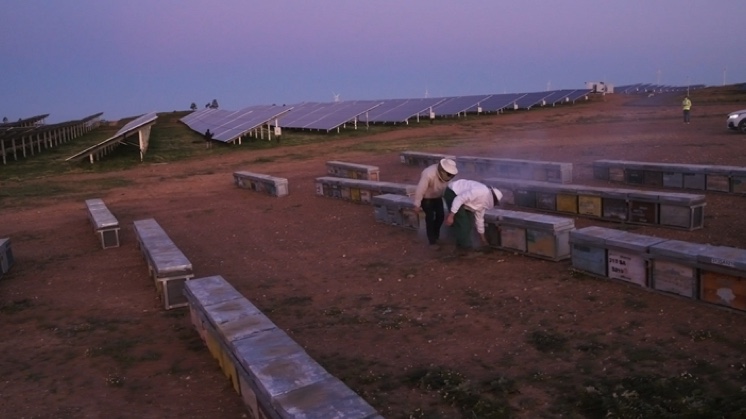
Installing beehives in the vicinity of photovoltaic plants.


The NewTech Challenge for solving challenges
Iberdrola regularly launches NewTech Challenges through its start-up programme PERSEO. Many of these challenges are focused on delivering innovative, competitive and sustainable solutions to preserve and protect the environment. You can review the latest projects through the programme by following this link.
Electrification to preserve ecosystems
At Iberdrola we are working every day towards an increasingly clean, efficient and sustainable energy model. We are committed to a system based on renewable energy and the electrification of the economy, convinced that electricity is the best way to decarbonise key sectors such as transport, industry and buildings. We also promote the development of smart grids, which optimise energy use, improve system efficiency and facilitate the integration of these renewable sources.