


Sustainable lifestyle
How to adopt a sustainable lifestyle? Tips for making a green commitment
The planet's resources are running out and we need to take steps quickly to adopt habits that are respectful of and healthy for the planet and future generations. Leading a sustainable life means more than being a responsible consumer. It is a question of living based on a commitment to the environment and making little changes to our daily lives.
According to World Health Organisation (WHO) data, there are now around 8.2 billion people living on the planet and that number is rising. Each of us has to eat, get about and consume goods and services. Unfortunately, a lot of people don't do this in ways that are responsible to the environment. The question is: Will the sustainable efforts made by just a few people make any difference? Most of the international organisations trying to preserve the planet say it will make a difference: "Every gesture counts", says Greenpeace.
In fact, a study by the University of Michigan in the United States confirms that the rules agreed upon by groups of the population guarantee the efficiency of a sustainable life strategy. The key? Each person's reputation serves as positive reinforcement for others, in other words, the fact that one person bothers to recycle correctly is inspiration for others. According to researchers, encouraging these little actions is as easy as following a few tips and doing environmental education.
What is a sustainable lifestyle
In 1986, the World Health Organization (WHO) defined the concept of lifestyle as “a way of life based on the interaction between living conditions in a broad sense and individual patterns of behaviour determined by sociocultural factors and personal characteristics”. A year later, the Brundtland Report, produced by the World Commission on Environment and Development, began aligning lifestyle and sustainability: “Development is sustainable when it meets the needs of the present without compromising the ability of future generations to meet their own needs.
Since then, the negative impact of our way of life on the environment has continued to increase. Overexploitation of natural resources, water pollution, soil pollution and deforestation, loss of biodiversity, among other things, have aggravated the environmental problems to be solved during this century. To address these major challenges, action has been taken to achieve a sustainable lifestyle globally that will prevent the planet from further deteriorating. Agenda 2030 and the Sustainable Development Goals (SDGs) are good examples. And young people, worried about their future, seem to be taking note.
Factors influencing a sustainable lifestyle
Achieving a sustainable lifestyle does not depend solely on individual factors; there are also collective and external factors that can either promote or hinder the achievement of this goal:
-

Individual factors
The way we relate personally to the environment in which we live determines our level of awareness of the need to protect the environment.
-

Collective factors
In some societies the concept of the common good is more deeply rooted than in others, which tend towards individualism, and this is reflected in customs that affect the environment.
-

External factors
Each country's or region's legislation, its geopolitical and economic situation and its level of innovation, amongst other factors, can either limit or encourage the adoption of a sustainable lifestyle.




What can we do? Tips for a sustainable lifestyle
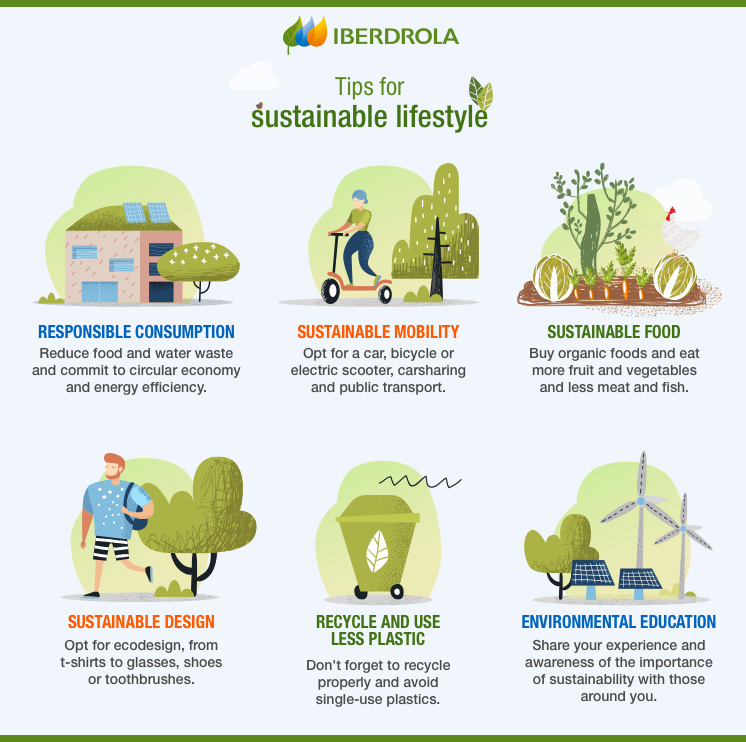
Leading a sustainable lifestyle involves changing our habits in ways that not only help to reduce our ecological footprint but also improve our health and wellbeing. Actions such as responsible consumption to prevent food waste, sustainable eating that promotes the consumption of organic produce and sustainable mobility that encourages the use of transport such as cycling help to improve our physical wellbeing whilst contributing to a cleaner planet. Reducing our carbon footprint also involves a change in the way we dress by choosing sustainable design; in the way we shop by prioritising recycling and reducing our use of plastics; and in the way we think by teaching the importance of sustainability to future generations.
What can businesses do to promote a sustainable lifestyle?
Companies can promote a more sustainable lifestyle by transforming their own processes and using their influence over employees, suppliers and customers to shift everyday habits towards low-carbon and low-waste options.
-

Integrating sustainability into their strategy
Companies must incorporate sustainability as a strategic pillar, opting for renewable energy, better water and waste management and reducing their carbon emissions. At the Iberdrola Group, we have incorporated sustainability throughout our entire value chain. Furthermore, we have set sustainability targets for 2030 with the aim of reducing our carbon footprint.
-

Promoting a low-emission working life
Companies can reduce emissions and promote more sustainable habits by encouraging remote working, flexible working hours and digitalisation, which reduces commuting and paper use. For example, according to Greenpeace, promoting remote working could save between 400 and 600 tonnes of CO₂ in cities such as Madrid or Barcelona.
-

Promoting sustainable mobility
Organisations can encourage a more sustainable lifestyle by offering incentives for employees to use public transport, cycle or use car-sharing schemes. For example, in Spain the Iberdrola Group has launched the Smart Mobility Plan, which includes several key measures to facilitate the adoption of electric vehicles and reduce environmental impact.
-

Embed a culture of reduce, reuse and recycle
Adopt the principles of “reduce, reuse and recycle” across day-to-day operations and workplace culture. Companies can prioritise reusable products such as mugs, water bottles and tableware, phase out single-use plastics and make recycling easier with clearly labelled waste bins. For example, The Walt Disney Company has implemented a waste reduction policy that sends organic waste to an external composting facility, where it is transformed into nutrient-rich compost used to fertilise plants.
-

Continuous training
Training is one of the most powerful tools for changing lifestyles, as it links knowledge with action. Companies can offer workshops on climate change, the circular economy, responsible consumption and energy efficiency, tailored to the reality of their workforce. One example is the Sustainable Suppliers programme, a training initiative promoted by the UN Global Compact, with Iberdrola as one of its driving forces. It is aimed at suppliers to large companies, with the aim of strengthening their training in sustainability.




Iberdrola and electrification as a driver of sustainable living
Replacing fossil fuels with clean energy enables a reduction in greenhouse gas emissions and is therefore a major step towards combating the pollution that affects ecosystems and our quality of life. In this context the Iberdrola Group is working to accelerate the electrification of the planet, moving towards an energy system capable of meeting growing demand in a sustainable, efficient and carbon-neutral way.
Electricity generated from renewable energy sources has the potential to completely transform highly polluting sectors such as urban mobility, making it more efficient by promoting the use of electric vehicles in urban areas instead of vehicles with internal combustion engines. This involves the use of cars, bicycles, motorbikes, buses and other modes of transport powered by electricity, as well as the roll-out of electric public transport systems and the development of public charging infrastructure.
Furthermore, household energy use is another area where electrification can improve sustainability, as the use of technologies such as LED lighting systems, energy-efficient appliances and electric heating and cooling systems can significantly reduce the use of fuels such as natural gas, thereby helping to reduce households' ecological footprint.
Electricity is therefore a key factor in reducing emissions, improving air quality in cities and promoting the development of clean energy technologies, such as energy storage systems and smart grids.
Circular economy model at the Iberdrola Group
At Iberdrola, we are working to be more respectful of nature through our three strategic sustainability priorities: climate action, biodiversity protection and the circular economy.
For this reason, our sustainable business model is based on circular economy principles, a resource-management system that prioritises reducing the use of new raw materials through process efficiency, extending product life cycles and promoting the reuse and recycling of materials.
We apply this approach throughout our value chain, building a decarbonised future alongside strategic partners who share our vision and values for environmental protection and preservation.
In 2025, we carried out circular economy initiatives related to wind turbine blade recycling, radioactive waste storage and reducing gas consumption.
Our circular economy targets
At Iberdrola, we have set a target of recycling more than 90% of wind turbine blades and solar panels by 2030. This goal is aligned with the new Nature Management and Protection Policy and its guiding principles.
| EFFICIENT USE OF RESOURCES | METRIC | 2025 | 2028e | 2030e |
|---|---|---|---|---|
| Blades and Solar Panels Recycling | Number (cumulative)1 | 947 | >3,000 | >5,000 (90%) |
(1) Estimate of recycled blades in 2030 according to the current operational plan and subject to revision depending on the evolution thereof. Target by 2030: 90% recycling of blades and panels.