Internet of Behaviour
What is the Internet of Behaviour?
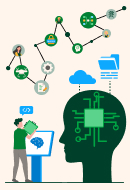
The connection between people and devices is generating an unprecedented amount of information. While the Internet of Things (IoT) enabled objects to collect data about their surroundings, the Internet of Behaviour (IoB) goes one step further by analysing that data to understand behaviours, anticipate needs and create more personalised experiences.

What is the Internet of Behaviour and where does it come from?
The Internet of Behaviour is a process of extracting individual patterns – which are multiplied on a massive scale thanks to the IoT – and then analysing them in terms of behavioural psychology. Based on this analysis, new approaches are developed for user experience (UX) design, search experience optimisation (SXO), companies' end products and services and how to promote them.
The advent of the so-called Internet of Behaviour (IoB) is actually almost a logical consequence of the birth of the Internet of Things. When internet connectivity reached televisions, watches and cars (giving rise to Smart TVs, fitness trackers and autonomous driving), companies began to collect thousands of pieces of data and information from users of these devices. For example, to recommend films similar to their tastes, to set small reminders when they had been sitting for too long or to create a smart car park.
This concept began to spread to give rise to what has come to be called the Internet of Everything (IoE) in which any entity establishes connections that open up new possibilities with related information. An example would be the so-called smart farms in which, by means of sensors, humidity, temperature, light or noise levels are measured and established and, in the same way, the state of the animals is reported through their heart rate or body temperature.
Faced with this enormous volume of data and patterns, there is a need to make effective use of them. It was psychology professor Gothe Nyman who, in 2012, described the possibility of obtaining data on people's behaviour when interacting with the Internet of Things and how important it is not only to have the data but also to be able to interpret and understand it.
A very simple example would be a nutrition app that includes the food we eat and which, in turn, is synchronised with an activity bracelet that measures our physical activity, sleep and hydration. Each one obtains a good amount of data which, compiled and analysed, gives rise to a series of recommendations on food, exercise or habits which, in essence, are promoting a change in behaviour.
Components of the Internet of Behaviour
The Internet of Behaviour (IoB) extends the Internet of Things (IoT) by interpreting how people interact with devices, services and digital environments. It is on the basis of these patterns that more useful and personalised experiences can be designed. The Internet of Behaviour is therefore a combination of three fields:
-

Existing technology
Connected devices, applications, sensors and digital platforms collect data on the use of a service. This infrastructure makes it possible to continuously record interactions.
-

The analysis of the data generated
Data is organised and analysed to identify patterns, trends and needs. In this way, it is transformed into information that can guide decision-making and improve services.
-

Behavioural psychology helps us understand them
It provides tools for interpreting why people make certain decisions. Applying it enables the design of solutions that are clearer, more accessible and tailored to actual usage habits.


Aplicações da Internet of Behaviour
A Internet of Behaviour tem aplicações em múltiplos âmbitos ao combinar dados provenientes de dispositivos conectados, inteligência artificial e análise avançada para compreender padrões de comportamento e oferecer soluções mais personalizadas, eficientes e adaptadas às necessidades das pessoas.
-

Health and wellbeing
Analysing habits relating to sleep, physical activity and diet enables the development of personalised recommendations and promotes a better understanding of each person's health and wellbeing.
-

Mobility
Information gathered from driving and travel patterns facilitates the development of smart routes, more efficient mobility and new solutions aimed at improving road safety.
-

Energy
Analysing energy consumption habits helps to identify opportunities for improvement, offer energy-saving recommendations and promote a more efficient and sustainable use of energy.
-

Retail and customer experience
Understanding users' preferences and needs enables services to be personalised, the shopping experience to be improved and more relevant communications to be established.
-

Smart cities
Applying citizen behaviour analysis helps to optimise the management of mobility, energy consumption and other public services to create more efficient urban environments.


IoB e eficiência energética
No âmbito energético, a Internet of Behaviour pode contribuir para compreender melhor os hábitos de consumo e oferecer recomendações personalizadas que ajudem a otimizar o uso da eletricidade. A partir da análise de dados provenientes de dispositivos conectados, medidores inteligentes e sistemas de gestão de energia, essas tecnologias podem favorecer um consumo mais eficiente, deslocar determinados usos para momentos mais adequados para o sistema elétrico e promover soluções como o autoconsumo, o armazenamento de energia ou a mobilidade elétrica.
A digitalização do sistema energético está reforçando o papel dos consumidores como participantes ativos da transição energética. Segundo a Agência Internacional de Energia (IEA), a flexibilidade da demanda será um elemento-chave para gerenciar sistemas elétricos com maior presença de energias renováveis, permitindo adaptar o consumo às necessidades da rede e melhorar sua eficiência. Além disso, os sistemas digitais de gestão de energia em residências podem integrar geração solar, baterias, veículos elétricos e dispositivos conectados para otimizar o consumo e a produção de energia.
Benefits of the Internet of Behaviour
The Internet of Behaviour is emerging within an increasingly mature technological landscape: the European Commission's report on the Digital Decade notes that 46.7% of EU businesses use cloud services, 39.9% employ data analytics and nearly 20% are already deploying artificial intelligence. This trend is set to continue until 2030, with forecasts suggesting that 75% of businesses will use cloud technologies and that there will be 10,000 climate-neutral and highly secure edge nodes (connection points close to the source). The combination of these infrastructures will enable more data to be collected and analysed than ever before, and there are also plans to do so in a more distributed, scalable and responsible manner.
This knowledge obtained from data analysis translates into multiple benefits, especially for companies that can create an improved user experience or a personalisation of the offers that are shown to us, thus optimising the relationship with the consumer and doing so in real time. The Internet of Behaviour therefore becomes a proactive technology as it not only analyses behaviour but also detects the variables that influence it in order to bring about a specific result.
Ethical dilemmas of the Internet of Behaviour
Like any technology that relies on personal information, the development of the Internet of Behaviour is at the centre of ethical debates concerning privacy, data protection and the responsible use of information obtained from behavioural patterns. Furthermore, as vast amounts of data are collected and intelligent systems continue to grow, regulatory frameworks must adapt to the internet’s evolving needs and new solutions must be explored. Some of these dilemmas include:
-

Transparency
Explaining what data is collected, how it is used and for what purpose so that users can understand how these systems work.
-

Consent and control
Enabling individuals to manage their preferences and have a say in the collection and use of their personal data.
-

Data minimisation
Collect only the information necessary for the intended purpose, thereby reducing the risks associated with data storage and processing.
-

Security
Protect information against unauthorised access, cyber-attacks or misuse that could compromise users' privacy.
-

Non-discrimination
Ensure that artificial intelligence-based models avoid biases that could lead to unfair or discriminatory outcomes.
-

Human oversight
Ensuring human intervention and review, particularly where automated systems may influence decisions that are significant to users.


Furthermore, it is important to recognise that artificial intelligence, particularly generative AI and predictive models, significantly expands the possibilities of the Internet of Behaviour as it enables more accurate analysis of behavioural patterns and the development of more personalised services. However, its development also poses new challenges relating to the explainability of systems, the governance of the data used to train models and the definition of ethical boundaries for responsible automation; this is why we must also question the limits that this AI may have in our daily use.
Iberdrola: data-driven innovation and privacy by design
The shift towards more connected energy services opens up new opportunities to understand consumption habits and improve efficiency. At Iberdrola we embed privacy by design and by default into our processes and solutions and we utilise technologies such as anonymisation, advanced encryption, secure execution environments, federated analytics and processing on encrypted data to protect sensitive information without compromising on innovation.
This commitment to cybersecurity extends to the protection of our customers' data. We implement technical and organisational measures to prevent loss, alteration or unauthorised access; we have incident response procedures in place; and we provide users with mechanisms to manage their preferences and exercise their rights. Our global privacy model and information security certifications reinforce a responsible approach to implementing the IoB: using data to improve the energy system and services whilst preserving the trust and control of those who make them possible.