


Battery Energy Storage Systems (BESS)
What are battery energy storage systems (BESS)?
Battery energy storage systems (BESS) are one of the key technologies to significantly help to integrate renewable energies and promote the economy’s electrification.

Ever since Alessandro Volta invented the battery in 1800, energy has been able to be stored for future use, either for a single use or in a rechargeable form. Batteries are a crucial component of any energy strategy, especially in today's context, as they stabilise power grids, improve integration of different renewable energies and in that way reduce carbon emissions. In its report 'Batteries and secure energy transitions', the International Energy Agency (IEA) has called for a six-fold increase in global energy storage capacity, considering them fundamental to achieving climate and energy objectives.
In this context, battery energy storage systems (BESS) are particularly relevant as they are an advanced technological solution to conserve energy and use it at a later date. They are not only batteries, they also incorporate a series of software and hardware tools to manage electricity supply, improve the efficiency of electricity grids by preventing brownouts and provide back-up power in blackouts.
How BESS work
Battery energy storage systems (BESS) work by storing electricity during periods of low demand or when there is excess production, and releasing it when demand is high or when there are power outages. The charge can come either from the grid or from renewable energy installations. The difference from an ordinary battery is its software which, using tools such as AI or data-driven solutions, can detect when it is time to release the stored energy, allowing for advanced management.
This management system also continuously monitors battery status, controlling factors like charge, temperature and life cycle to ensure safe and efficient operation so that when there is a high electricity demand or a brownout, everything works correctly and can be used by consumers or redistributed to the grid.
BESS battery components
Now that we know what a BESS system is and how it works, we have to ask what it consists of and what its essential parts are. They can be divided into:
- Batteries: These are the main component of the system, where energy is stored. There are different types and the most common technologies used to store renewables include:
- Lithium-ion: They have a high energy density and a long life cycle.
- low batteries: These offer the longest lifetime and are usually better for large installations.
- Battery Management System (BMS): Controls charge and discharge status, monitors temperature and ensures safe and efficient system operation.
- Power Conversion System (PCS): Devices that convert direct current (DC) stored in batteries to alternating current (AC) for the grid or end consumers.
- Energy Management System (EMS): This is the system’s core, responsible for monitoring and managing the power flow between the equipment and the batteries. It coordinates the work between the different BMS, PCS and other auxiliary components.
A BESS: what it is and what it is made of
A Battery Energy Storage System (BESS) plays a crucial role in stabilising electricity grids, helping to integrate renewable energy and improve energy efficiency. These are its main parts.
Batteries
This is the main component of these systems, where energy is stored. They are made up of several elements.

Power Conversion System (PCS)
These are devices that convert the direct current (DC) stored in batteries to alternating current (AC) for use by the grid or end consumers.

Electricity grid
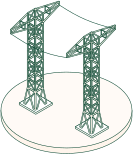
Renewable sources
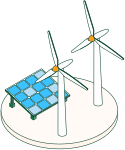
An energy storage system can be combined with renewable sources to store energy and maintain grid stability despite unplanned fluctuations in electricity generation.
Energy Management System (EMS)
The core of the system, responsible for monitoring and managing the power flow between the equipment and the batteries. It coordinates the work between the different BMS, PCS and other auxiliary components.


Essential terms and performance criteria for BESS storage
To be a true expert in BESS systems you need to know some essential terms and criteria that have to do with system performance. Some are easy to understand like lifetime, temperature and response time, but others are more technical and require a bit of an explanation. Here are some of them:
-

Storage capacity
The amount of energy the system can store.
-

Energy density
How much energy can be stored in a given volume.
-

System power and system density
he former refers to the amount of energy the system can deliver and the latter to the amount of energy it can deliver for a given volume.
-

Round-trip efficiency
The ratio of energy used between charging and discharging the battery or the energy lost during each cycle.
-

Depth of Discharge (DoD)
The percentage of energy discharged in relation to the total capacity of a battery.







Advantages of BESS over other energy storage systems
There are clearly many benefits to energy storage systems and although some of them have already been discussed, let's recap what the main advantages of BESS are. They:
-

Efficiency in renewables
Stabilises and efficiently integrates renewable energy.
-

Lower emissions
Contributes to the reduction of greenhouse gas emissions.
-

Optimise costs
Produce cost savings because they can store energy when tariffs are lower to consume during peak hours.
-

Flexible management
Offer flexibility when managing energy demand.
-

Backup system
Becomes a fast-response backup system, maintaining grid stability regardless of demand peaks or extreme conditions faster than other traditional systems.
-

Easy deployment
Faster and cheaper installation compared to other storage systems, making it an easily scalable option.


Importance of BESS systems for renewable energies
Battery energy storage systems are crucial for renewable energy because of their ability to mitigate the intermittency inherent in sources like solar and wind. These energy sources don’t always produce electricity consistently: the sun doesn’t shine at night and the wind doesn’t always blow with the same strength. BESS can store excess energy generated during periods of high production and then release it when generation is low or demand is high. This ensures a constant and reliable supply of electricity, even when weather conditions are not ideal for renewable energy generation.
BESS therefore facilitates the integration of more renewable energy into the electricity grid without compromising its stability due to fast-happening unplanned fluctuations in power generation. By using BESS, a more constant and predictable flow of energy can be produced, which in essence allows for a greater penetration of renewable energy in the overall energy mix.
Overall, BESS contribute to reducing greenhouse gas emissions by maximising the use of renewable energy and minimising dependence on fossil energy sources. By providing an effective solution for energy storage, they make renewables a more viable and competitive option. This is key for the transition to a more sustainable and less carbon-dependent energy system.
The future of BESS batteries
BESS batteries are consolidating themselves as a fundamental infrastructure to achieve electrification targets through renewable and clean energy. Their technological evolution must accompany the new needs of the electricity network, becoming support elements for many years and a flexible system that grows alongside it.
Currently, BESS batteries have a useful life ranging between 10 and 15 years, depending on the charge and discharge cycles to which they are subjected. Battery maintenance conditions can also affect their duration. Under optimal conditions, they could operate for 20 years.
In addition to optimizing their useful life, the sector is moving towards space optimization, creating cells with higher storage capacity but smaller sizes to facilitate implementation through a reduction in costs associated with construction work, cabling, transformers and general conditioning of the site where they are installed.
Along the same lines, there is a growing need in the sector for advanced monitoring of the state and health of batteries, according to the article “Powering the future: Strategies for battery energy storage developers” published by the consulting firm McKinsey. This massive collection of battery information can help predict the degradation of certain components, for example, helping implement a proactive maintenance strategy to keep the system in optimal conditions.