


Interview with Sushma Garudadwajan, a SCADA Engineer at SP Electricity North West
“A SCADA system is our ‘eyes and ears’ across our network”
What is a SCADA system? What role does it play in electricity infrastructure and what happens if it fails? Sushma Garudadwajan, a SCADA Engineer at SP Electricity North West, one of our electricity distribution companies in the United Kingdom, gives us an insight into her day-to-day work and the importance of SCADA systems for the smooth running of the electricity network.
 Publication: 3 September 2026
  Reading time: 9 minutes
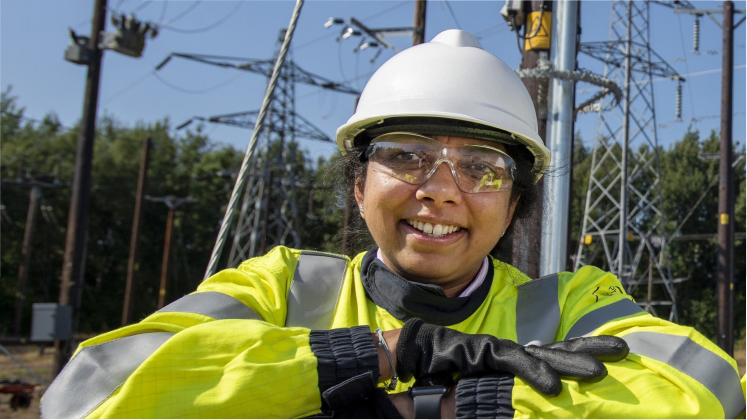
Key points from the interview:
- SCADA is a remote control system that monitors the electricity grid in real time and enables control engineers to operate equipment remotely.
- An effective SCADA team must combine technical skills with a good deal of creativity and curiosity, driving them to innovate in the design of the smart communications of the future.
- Artificial intelligence, within a SCADA system, is mainly used as a tool for checking and validating large volumes of comparative data, but it does not replace the human factor, which is key when making critical decisions and assessing situations outside the norm.
An efficiently and intelligently operating grid needs to have a robust technological infrastructure that constantly monitors all key points in order to respond to any unforeseen event. But it also needs to improve the service every day. In this scenario, SCADA systems are key to capturing data, making real-time decisions and collecting large volumes of data that help drive further innovation.
What is a SCADA system and why is its implementation essential in the energy sector
To help everyone understand, what does a SCADA Engineer do?
SCADA stands for Supervisory Control and Data Acquisition – it's a technology that gives real-time visibility and control of field devices such as substations, feeders, switches and transformers.
A SCADA engineer is responsible for the systems that allow control engineers to monitor, control and automate our electricity distribution network from a central control room.
We work with the control hub to see quickly where a fault has occurred, which customers are affected and use remote switching to get them back on supply.
Now let's get a bit more technical. Could you explain what a SCADA system is and what role it plays within a company such as Iberdrola?
At SP Electricity North West, a SCADA system is our “eyes and ears" across our network. It’s a remote-control system that enables control engineers to monitor the network in real time and operate equipment remotely. Tasks that could take hours to complete manually on site can often be carried out in just a few minutes using SCADA.
The system helps us to gather data from our network equipment out in the field and provide a better level of protection, automation and monitoring functions to ensure we can get customers power back on as soon as we can.
What knowledge or skills should a professional have if they want to work as a SCADA Engineer? Within your team, what different profiles are required and how do they contribute to the smooth operation of the system?
To work as a SCADA Engineer at SP Electricity North West you need to have a combination of electrical engineering knowledge, control systems expertise, communication network protocols (i.e. DNP3) and practical troubleshooting ability.
It’s also really important to be knowledgeable about cyber security and the risks it can pose to our network systems.
A successful SCADA team collectively requires a good mix of skills, with equal measures of precision and creativity. Our team of engineers combine their engineering expertise with technical knowledge and have the curiosity to challenge convention and drive innovation. Day-to-day that can mean everything from hands-on wiring to shaping the future of smart communications and network technologies. It’s really varied and our engineers play a vital role both within the office and out in the field.
The importance of correctly designing and implementing a SCADA system
What technologies are required for a SCADA system to operate effectively?
A typical SCADA system consists of:
Remote Terminal Units (RTUs) and Intelligent Electronic Devices (IEDs)
RTUs collect data from field equipment and send it back to the control hub. IEDs provide protection, automation and monitoring functions, helping to detect and respond to network issues.
Field devices
These are physical pieces of equipment installed in substations and across our network, including circuit breakers, switches, transformers, etc.
Communication network
Information is transmitted between field devices and the control hub using fibre-optic networks, radio communications and cellular networks.
Control centre system (SCADA Master)
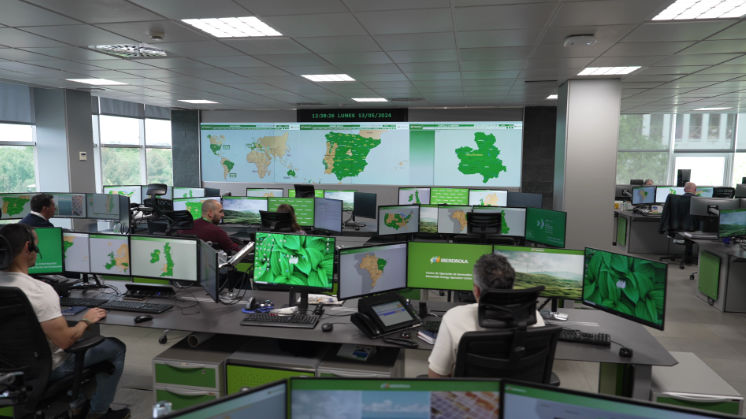
Control engineers use geographical displays to view the status of the network and remotely monitor and operate equipment.
These technologies work together to allow utilities to monitor, control and manage the electricity network in real time.
What impact does a SCADA system have on a company, in this case the Iberdrola Group
The SCADA system is a game-changer for the Iberdrola Group, delivering significant benefits that improve how we operate and serve our customers.
It gives us the capability to build, maintain and operate smarter, more resilient networks while ensuring we continue to deliver a safe, reliable and efficient service for our customers at a regional and global level.
Imagine you wake up tomorrow and all SCADA systems have stopped working. What would happen in that situation? What impact would it have on the public? Would people notice? And for your team, how many professionals would be affected by this failure in carrying out their day-to-day work?
Oh! That’s a nightmare I would never want to have!
If it did happen and all SCADA systems stopped working, the electricity network wouldn’t instantly stop working. We would however lose the ability to monitor and control the network remotely, leading to a slower fault response and potentially longer outages for customers.
Because SCADA can quickly detect and restore power remotely, some customers may not even realise they’ve had a power cut so if the systems stopped working our response time would take longer, impacting more of their lives and could greatly impact our customer satisfaction scores.
Our SCADA team would have their day-to-day roles impacted as they couldn’t work as normal, but they could support in our response to getting the system working again.
A SCADA system is not just a control room full of screens. It also connects to different parts of the infrastructure to monitor what is happening in real time and support the most appropriate decision-making. How is the entire process designed, from the sensors through to the interface, to prevent errors and ensure clear, agile decision-making
SCADA is built in layers and can be as simple as 1, 2, 3.
One control room, that enables us to remotely open and close parts of the network.
Two types of Remote Terminal Units (RTUs) to control our primary and secondary network.
Three different types of signals to obtain data from the sensors and send controls to field equipment.
The design starts at field level and extends across various communications, data processing, etc. to support fast, informed decisions and responses.
Connectivity, artificial intelligence and cybersecurity: keys to ensuring a SCADA system works
Today, real-time monitoring is a key priority. How would you describe the convergence of IT and OT today?
Businesses are relying on data to drive strategy, and the SCADA system provides up-to-date data in a very accessible way by linking IT and OT systems together. This convergence needs careful management to ensure that neither system is compromised or exposed to threat which means that IT and OT teams need to work closely together.
The energy sector has become one of the most critical infrastructures in any country, making security in all its forms essential. What role do physical security and cybersecurity play within a SCADA system?
Physical security focuses on protecting personnel and key assets like the control room, substations, Remote Terminal Units (RTUs), data centres, field sensors and instrumentation and telecommunications infrastructure.
Cybersecurity protects the communication networks, servers, applications and data that enable SCADA operations.
Neither can be effective in isolation, integration of physical and cyber protections is critical. We need to ensure that control engineers can trust the information they receive, maintain situational awareness and make safe, timely decisions to keep our energy network secure and resilient.
Artificial intelligence is playing an increasingly important role in companies. What role does it currently play in a SCADA system and what is your prediction for the future? Could it replace the human element in any of the SCADA layers
Artificial Intelligence (AI) is definitely becoming an important tool in SCADA systems, but today it mainly assists people rather than replace them. In the current phase of the SCADA upgrade project, we use AI tools to check and validate large amounts of comparison data, which saves a lot of time.
I think in the future, AI will likely take on more routine tasks such as monitoring equipment, generating reports and optimising automation sequences. However, I don’t believe it will completely replace the human element, especially when it comes to making safety critical decisions and making a judgement for unusual events.
The work of a SCADA Engineer is not confined to the office; it also involves working out in the field. How would you describe the work carried out in each of these two 'offices'
That is very true, my role is not confined to the office at all. Though I spend a lot of time at my desk designing, configuring RTU/SCADA databases and analysing automation sequences, I get an opportunity to be in the workshop configuring, testing and troubleshooting RTUs. This is a perfect balance between an office type of task and a hands-on workshop role. There is absolutely no monotony in what I do.
What advice would you give to someone who would like to become a SCADA Engineer?
Go on, give it a try – you might be the one powering the future.