


Edge computing
Edge computing: quicker, smarter, and more sustainable device
Edge computing processes data close to where it is generated, enabling devices, facilities and infrastructure to respond more quickly. This technology powers real-time AI, industrial IoT and smart grids and complements the cloud's analytical capabilities.

Edge computing can contribute to a more efficient use of digital resources by filtering data locally and reducing the need to transmit unnecessary information to remote data centres.
Digitalisation connects millions of devices, sensors and pieces of equipment capable of generating information continuously. In an electrical network, a factory, a connected vehicle or a renewable energy facility, much of this data needs to be analysed the very moment it is produced.
This is where edge computing comes into play: a technological model that brings processing power closer to where the data is generated. Instead of sending all the information to remote data centres, part of the analysis takes place on the device itself, at a nearby facility or at a local communications node.
This approach enables faster responses, optimises the use of communications and enhances the continuity of certain services. The European Commission identifies the combination of cloud, edge, the Internet of Things (IoT) and artificial intelligence as a key technological foundation within its research and innovation initiatives and its data strategy.
What is edge computing?
Edge computing is a distributed computing architecture that processes data close to its source: a sensor, a camera, a smart meter, an industrial machine or a vehicle, among other devices.
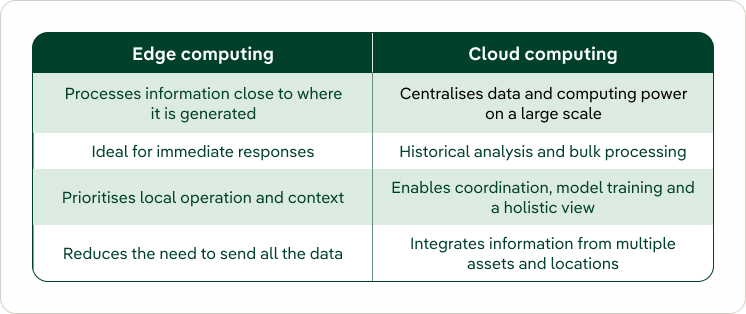
It does not replace cloud computing but rather complements it. While the edge enables immediate actions to be carried out and information to be filtered within the local environment, the cloud facilitates storage, large-scale analysis, model training and the coordination of multiple assets.
Differences between edge computing and cloud computing
The importance and challenges of edge computing
The value of edge computing lies in its ability to bring digital intelligence closer to physical assets. This is particularly important when a decision cannot wait for data to travel to a remote processing centre.
-

Real-time response
It reduces the time between the detection of an event and the necessary action.
-

More efficient use of communications
It filters and prioritises information before sending it to the cloud, which helps to manage large volumes of data.
-

Greater operational resilience
It enables certain capabilities to be maintained locally even if connectivity to central systems is limited.
-

Better understanding of assets
Facilitates more granular monitoring of equipment, facilities and infrastructure
-

More efficient operations
It can help to optimise resources and travel by identifying incidents and maintenance requirements in advance.
-

Lower latency
It processes data close to its source, reducing the time taken to send information to remote data centres and receive a response.


Edge computing offers a range of benefits. However, to realise its full potential it is also necessary to address issues relating to security, device management and information governance.
Challenges for its deployment
-

Distributed cybersecurity
With more devices and processing points it is necessary to protect a broader technological landscape and implement security measures in a coordinated manner.
-

Interoperability
The integration of devices, systems and platforms from different manufacturers requires standards and architectures that facilitate the exchange of information.
-

Device maintenance
Equipment deployed across distributed locations requires monitoring, maintenance and replacement where necessary to ensure its availability.
-

Data governance
It is important to establish criteria on how data is collected, stored, processed and shared, as well as on who can access it and for what purpose.
-

Updating AI models
When edge computing incorporates artificial intelligence, the models must be kept up to date and monitored to ensure their performance and reliability.
-

Scalability
Scaling up the number of devices and applications requires architectures capable of managing a distributed environment without compromising security, performance or operational capability.


How edge computing technology works
Edge computing combines local processing power with central systems to turn data into useful decisions.
-
Devices capture information about their environment and operation
-
A nearby device filters, analyses and prioritises the relevant data
-
The system can detect an incident, adjust an operation or alert a team
-
The system integrates selected data into central platforms to analyse trends and improve models
-
Greater agility, resilience, operational efficiency and better service
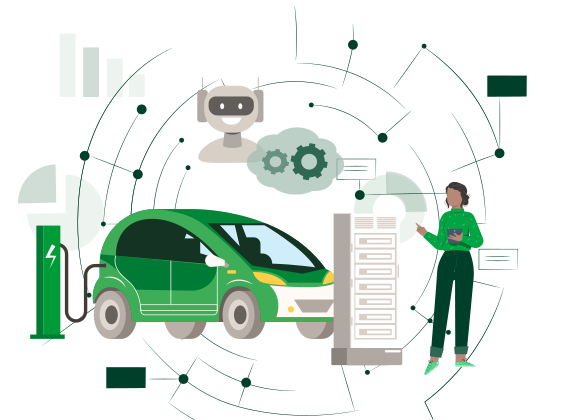
 SEE INFOGRAPHIC:
Edge AI: artificial intelligence at the edge
The evolution of edge computing has given rise to what is known as edge AI: the application of artificial intelligence models directly on devices or nodes close to the point of operation. Thus, cameras, sensors or connected devices can recognise patterns, classify events and generate alerts in real time.
Edge AI enables decision-making where speed, availability and local context are crucial. Its deployment must incorporate cybersecurity, human oversight, data quality and governance models that ensure responsible use.
The European Union has set itself the target of deploying 10,000 climate-neutral and highly secure edge nodes by 2030, with the aim of providing low-latency data services.
Meanwhile, the International Energy Agency (IEA) forecasts that global electricity consumption by data centres will exceed 945 terawatt-hours by 2030 – more than double the current level – driven mainly by the growth of artificial intelligence. This forecast highlights the importance of continuing to develop efficient digital architectures. Furthermore, in this context edge AI can complement cloud processing by analysing locally those data that require an immediate response, although its impact on energy consumption will depend on how the infrastructures are designed and managed, and on the tasks carried out in each environment.



Applications of edge computing
The benefits of edge computing will enable the implementation of numerous technologies in our environment – homes, vehicles, cities, etc. – and the optimisation of many others. Below we review some of them:
-

Autonomous vehicles
Smart cars collect information about their surroundings while driving – traffic signals, other vehicles, pedestrians, etc. The processing speed enabled by edge computing is crucial for driverless vehicles to respond in real time to traffic conditions and make this innovative form of mobility viable.
-

Smart grids
Electricity networks are increasingly incorporating distributed resources: renewable generation, storage, self-consumption, charging points, heat pumps and smart meters. Distributed processing enables better monitoring of the networks' status, the detection of incidents and more dynamic management of energy flows.
-

Renewable energy
Wind farms, solar power stations and other energy facilities generate constant data on their performance and status. Analysing this data close to the asset can streamline predictive maintenance, improve operations and enhance equipment safety.
-

Smart factories
By analysing all the data generated by factory machinery, Industry 4.0 can benefit from smarter production processes that improve efficiency, quality and sustainability, as well as from better interaction between cobots (collaborative robots) and humans, thereby preventing accidents and minimising the damage caused by them.
-

Smart cities
Connected vehicles, traffic management, smart lighting and electric vehicle charging all require the rapid exchange and analysis of information. Edge computing helps systems react to real-time conditions in their environment, transforming urban areas into smart cities.


Iberdrola: committed to smart grids
At Iberdrola we are driving the digitalisation of our electricity networks to move towards a more efficient, reliable energy system that is prepared for the needs of the future. As part of this journey, we are developing solutions based on edge computing that bring analytical and decision-making capabilities closer to our energy infrastructure.
This technology enables information to be processed at key points in the grid, such as substations, and enhances its management through the integration of data, artificial intelligence, the Internet of Things (IoT) and automation. In this way, we are helping to improve the quality and continuity of supply while making progress in the development of smart grids.
Digitalisation forms part of our commitment to electrification. A more connected and flexible electrical network facilitates the integration of renewable energy, energy storage, electric mobility and other essential resources to build a cleaner, more sustainable and more resilient energy model.