Blades
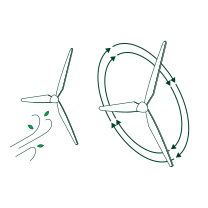
The most commonly used structure – and the one used by Iberdrola – has three blades moving along a horizontal axis. These rotate when pushed by the wind, transforming kinetic into mechanical energy.
Energy efficiency Onshore wind
Onshore wind energy, a clean and inexhaustible source that has been used for centuries, represents one of our main sustainable bets for the future, but there is still a lot of ignorance about how it works. For this reason, we propose 10 relevant terms to understand how it works and to know in detail each of its parts.

The use of wind power dates back to ancient Egypt with the first sailing ships, which harnessed this inexhaustible natural resource to move along the Nile River. Thousands of years have passed until the present day, but wind is still an important source of energy generation: today onshore wind represents one of the main sustainable bets for the future. And to make the most of the potential of these air currents, wind farms are springing up with dozens of wind turbines that are capable of supplying thousands of homes with 100% clean energy.
To better understand how this key renewable technology supports progress toward a more sustainable energy model, it is useful to become familiar with its main components. Here we analyse the 10 most important terms in onshore wind energy, including what a nacelle is and the role of the gearbox in a wind turbine.
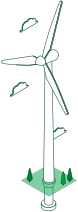
This is perhaps the main word in the list of the 10 most relevant terms in onshore wind energy. A wind turbine is a device capable of converting the kinetic energy of the wind into electrical energy. They are the giants of onshore renewable energy that can reach a total height of more than 250 metres up to the tip of the blade at their highest point, and when installed together they make up what are known as wind farms.
As its name suggests, the tower is the vertical structure, usually with a tapered cylindrical shape, that supports the rotor and the nacelle. In onshore wind turbines, towers typically stand between 80 and 160 metres tall, although larger models can reach or exceed 180 to 200 metres. The tower is designed to withstand the loads generated by the wind while supporting the nacelle and rotor, which together can weigh between 100 and 300 tonnes in the largest onshore wind turbines – roughly equivalent to the weight of several dozen adult elephants. The choice of construction material is fundamental to the tower's performance. Steel towers remain the most common, although hybrid towers combining steel and concrete, as well as fully concrete towers, are becoming increasingly widespread.
In addition, it can be equipped with a lighting system and have appropriate colours in order to be more visible to air traffic.
The hub is the element that connects the three rotating blades and the main shaft. Once the blades are moved by the force of the wind, this element is responsible for transmitting the mechanical energy to the inside of the nacelle, specifically to the gearbox.
United to the turbine through the hub, the blades play a fundamental role in generating clean energy. They typically measure between 40 and 85 metres in length and capture the energy of the wind, rotating at wind speeds from around 3-4 metres per second (m/s) up to approximately 25 m/s. This is made possible by their aerodynamic design, which maximises their ability to capture energy from the wind. Most blades are manufactured from glass fibre-reinforced polyester or epoxy resin, although some also incorporate carbon fibre or aramid fibres such as Kevlar
In addition, it may be fitted with a lighting and colouring system to make it visible to air traffic.
The rotor is known as the rotating part of the turbine. It contains the three blades of a wind turbine and the hub, which is the central structure that connects each of the blades. Its function is to capture the kinetic energy of the wind and transform it into the mechanical rotational energy of the shaft, which is then connected to the gearbox. This transformation capacity is limited to 59% (Betz limit). The maximum power that a wind turbine can produce depends on its size.
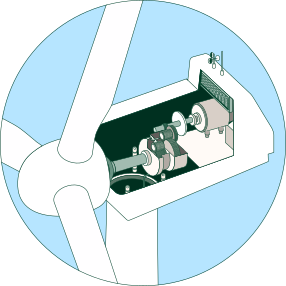
The most commonly used structure – and the one used by Iberdrola – has three blades moving along a horizontal axis. These rotate when pushed by the wind, transforming kinetic into mechanical energy.
Supports the rotor and nacelle, keeping them high enough to catch stronger, steady winds. It can be made of steel, concrete or a combination of both.
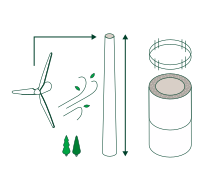
Concrete foundation that supports the entire wind turbine. In the case of offshore wind turbines, the foundation may be underwater.
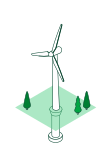
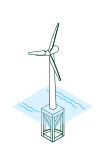
Composed of the blades and the hub. It is the part responsible for capturing the wind’s kinetic energy.
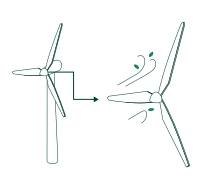
The casing at the top of the tower that contains all the mechanical and electrical parts, including the generator, gearbox and control system.
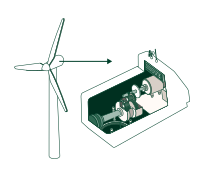
This is the central part of the rotor the blades are attached to. It transmits the mechanical energy generated by the movement of the blades to the low-speed shaft.
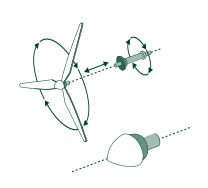
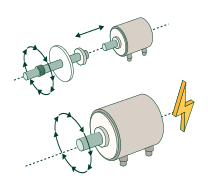
Connects the rotor to the gearbox and rotates at the same speed as it does.
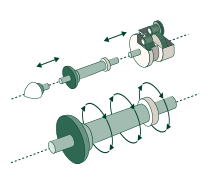
Raises the shaft’s rotational speed and rotates at a speed that allows the generator to operate.
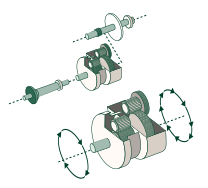
Connects the gearbox to the generator and rotates at a speed that allows the generator to operate.
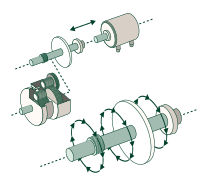
Converts mechanical energy into electricity. Its design may vary depending on the type of wind turbine.
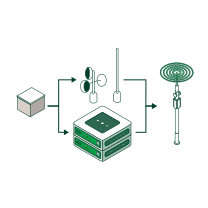
Allows the wind turbine to be monitored and regulated to optimise energy production and ensure safety. It includes a series of sensors that collect and send data over a communications line.
1 of 11
Also known as a nacelle, it refers to the structure at the top of the tower that houses all the internal components, such as the transmission system and the electricity generator. They exist primarily to protect these elements from external weather conditions.
In addition, it may be fitted with a lighting and colouring system to make it visible to air traffic.
The gearbox is located inside the nacelle and connects the rotor to the electrical generator via the main shaft. Its function is to increase the rotational speed produced by the blades, which typically rotate at between 10 and 40 revolutions per minute (rpm), to the speed required by the generator to produce electricity, usually around 1,500 to 1,800 rpm.
To achieve this, the gearbox uses a system of gears that increases the rotational speed before the movement reaches the generator, where the mechanical energy of rotation is converted into electrical energy. Not all wind turbines use a gearbox. Some models employ alternative technologies, such as direct-drive generators, which eliminate the need for this component.
The electrical generator is the component that converts the mechanical energy produced by the rotating blades into electrical energy. It uses a system of magnets and conductive materials that generate an electric current as the shaft rotates. There are several types of generators. Most wind turbines use asynchronous generators, although some models incorporate synchronous generators, an alternative technology that can be adapted to the operational requirements of each turbine.
The electrical energy produced in the generator needs to be adapted to the conditions of the electrical grid to which the wind turbine is connected by means of a converter. This is one of the processes prior to transporting the electricity generated by the wind to a substation, and from there to places of consumption, such as homes.
Every wind turbine in an onshore wind farm needs to transmit the loads to the ground/earth. The element that ensures this function is the foundation. Made of reinforced concrete, the foundation additionally provides a high stabilising capacity for the wind turbine as a whole thanks to its own weight. At present, its ground plan dimensions are around 20-25 metres. The tower is anchored to the foundation by means of steel connectors (bolts).
In addition to the main components of a wind turbine, several other systems and concepts are essential to understanding how onshore wind farms maximise performance, improve efficiency and ensure reliable electricity generation throughout their operational lifetime.
At Iberdrola, we committed to renewable energy more than two decades ago as a fundamental pillar on which to build our safe, clean and competitive business model. Thanks to this vision, we are currently world leaders in renewables, reaching 45,830 MW of clean energy in operation by the end of the first half of 2026.
This commitment is reflected in the €21 billion that our Strategic Plan 2025-2028 allocates to Renewables and Customers, with 38% dedicated to offshore wind, 24% to onshore wind, 10% to solar photovoltaic and another 10% to energy storage.