Blades
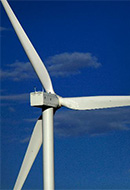
The most commonly used structure – and the one used by Iberdrola – has three blades moving along a horizontal axis. These rotate when pushed by the wind, transforming kinetic into mechanical energy.
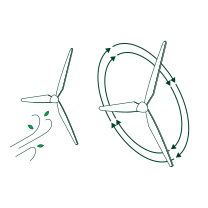
Wind turbines are huge windmill-like devices that can harness the power of the wind on a large scale, multiplying its force and converting it into electrical energy that can be transmitted to the grid and distributed to users. Installed at onshore or offshore wind farms, wind turbines are at the heart of wind energy generation: clean and renewable.
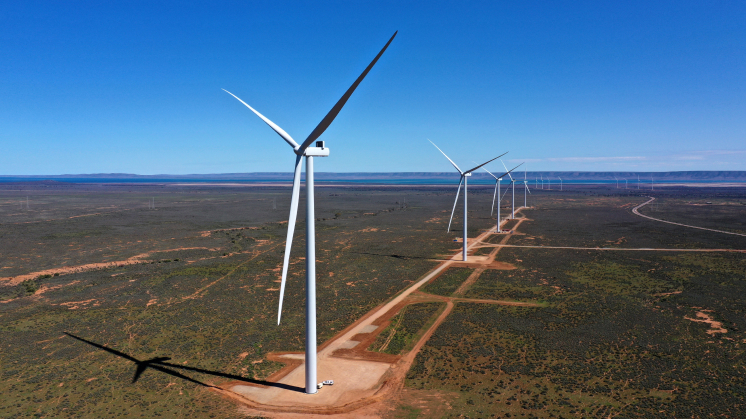
The machines that convert the wind energy contained in the wind into electrical energy are called wind turbines or aerogenerators. There are several types, by size and shape, although the most widespread and efficient are the three-bladed wind turbines with a horizontal axis, which you may have seen on occasion forming part of the skyline of a rural area.
They are usually grouped together within larger wind farms, ideally located at high altitudes, where the wind blows strongly, and away from obstacles such as buildings, hillsides or trees that can cause wind turbulence.
Wind turbines – which we could define as "the windmills of the 21st century" – are fascinating machines that harness the power of the wind to move their blades, which then turn the generator that produces electricity. We’ll explain in five simple steps how they convert this natural resource into renewable, clean and accessible energy.

Capturing the wind
To transform the movement of air currents into electrical energy, the wind first turns the huge blades of the wind turbines, which are aerodynamically designed to capture as much of this kinetic energy as possible and maintain a constant rotation even in very light winds (starting at 11 km/h).

Rotational motion
The blades are connected to the turbine by a main shaft. When the wind moves the blades, this horizontal shaft, also called the slow shaft, starts to rotate at the same speed (7 to 12 revolutions per minute) activating a series of gears.

Speed multiplication
This gear system, or multiplier, increases the rotational speed of the slow shaft by more than 100 times and transfers it to the fast shaft, which moves at more than 1,500 revolutions per minute. This speed increase is essential for the efficiency of conventional generators, although some technologies use low-speed generators coupled directly to the slow shaft.

Electricity generation
The mechanical force of each of these rotations is transmitted to the generator, where it is now transformed into electrical power, and from there to the converter, which turns it into alternating current.

Electricity distribution
The electricity generated is passed through a transformer that increases its voltage to high so that it can be transmitted over long distances. This electricity is then sent to the grid to reach the places where it is needed.
While doing their job, wind turbines are equipped with constant monitoring and adjustment systems. They have sensors that ensure that the blades always point in the direction of the wind to maximise efficiency and, if the wind is too strong (over 90 km/h), they can even slow down the blades to prevent damage
A wind turbine is a complex piece of engineering with thousands of small pieces, forming numerous parts, which in turn make up the various elements that are essential for it to operate.
To get a general idea, a wind turbine can be divided into five basic parts, some of which we have already mentioned: base, tower, nacelle and rotor.
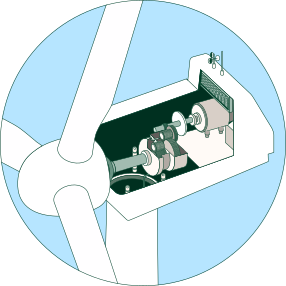
The most commonly used structure – and the one used by Iberdrola – has three blades moving along a horizontal axis. These rotate when pushed by the wind, transforming kinetic into mechanical energy.
Supports the rotor and nacelle, keeping them high enough to catch stronger, steady winds. It can be made of steel, concrete or a combination of both.
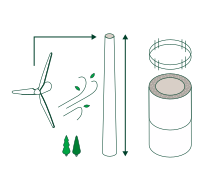
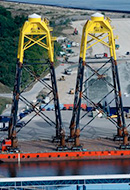
Concrete foundation that supports the entire wind turbine. In the case of offshore wind turbines, the foundation may be underwater.
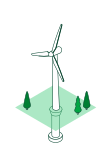
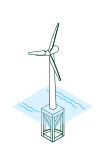
Composed of the blades and the hub. It is the part responsible for capturing the wind’s kinetic energy.
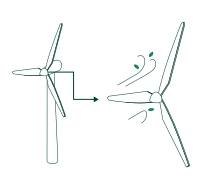
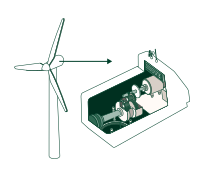
The casing at the top of the tower that contains all the mechanical and electrical parts, including the generator, gearbox and control system.
This is the central part of the rotor the blades are attached to. It transmits the mechanical energy generated by the movement of the blades to the low-speed shaft.
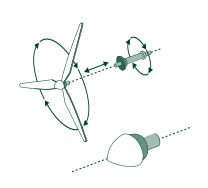
Connects the rotor to the gearbox and rotates at the same speed as it does.
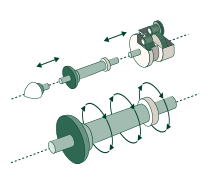
Raises the shaft’s rotational speed and rotates at a speed that allows the generator to operate.
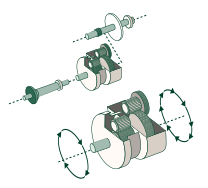
Connects the gearbox to the generator and rotates at a speed that allows the generator to operate.
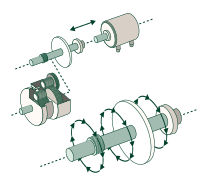
Converts mechanical energy into electricity. Its design may vary depending on the type of wind turbine.
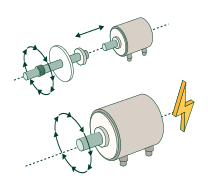
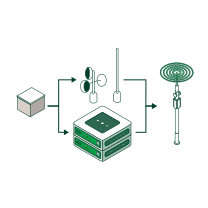
Allows the wind turbine to be monitored and regulated to optimise energy production and ensure safety. It includes a series of sensors that collect and send data over a communications line.
1 of 11
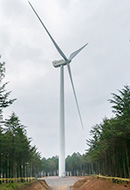
What is the most efficient place to install a wind turbine?
Wind turbines can be divided in two different ways. First, by the orientation of their axis of rotation: horizontal axis wind turbines and vertical axis wind turbines. Second, by their location: onshore or offshore wind turbines. All options have their own characteristics, advantages and disadvantages.
Horizontal axis wind turbines (HAWT) are the most common as they are highly efficient. They have three or more blades attached to an axis of rotation parallel to the ground, causing the blades to rotate in a plane perpendicular to the ground. Their performance improves in places with strong constant winds, which is why they usually have a tall tower. They are ideal for large wind farms and offshore applications.
The axis of rotation of vertical axis wind turbines (VAWT) is perpendicular to the ground, which means that the blades rotate in a plane parallel to the ground. Since they don’t need to be reoriented according to the wind’s direction, they are more versatile, easier to maintain and easier to integrate into urban environments due to their smaller size and lower height requirements. They are, however, less efficient and are generally used in smaller applications.

Turbines that sit on an onshore surface are the most commonly seen turbines used to take advantage of onshore wind energy. There is a wide variety of models, which can be adapted to the specific conditions of each site and can vary greatly in size and installed power.
Today, onshore wind turbines can range from mini- or micro-wind turbines up to heights of more than 150 metres and rotor diameters of 145 metres.
For the production of offshore wind energy, there are wind turbines that are anchored to the sea floor by means of different types of fixed foundations, designed to be submerged up to approximately 60 metres. These wind turbines can have a rotor diameter of up to 220 metres, with a consequent increase in power.
To harness wind energy in deeper waters, where the wind blows stronger and there are fewer obstacles, we resort to floating offshore wind energy, where the turbines – more than 120 metres high – are supported on floating platforms anchored to the seabed by underwater cables.