


Virtual power plants (VPPs)
What is a virtual power plant (VPP) and how does it work?
A virtual power plant (VPP) is a digital platform that coordinates distributed energy resources – such as batteries, electric vehicles, renewable facilities and flexible consumption – so that, when aggregated, they can provide flexibility to the electricity system in line with the needs of the network, the market and the applicable regulatory framework.
The increasing electrification of the economy and the growth of renewable energy are transforming the way the electricity system is operated. In this context, it is becoming increasingly important to have solutions capable of coordinating distributed resources – located in homes, businesses and industrial facilities – so that, collectively, they can contribute to balancing generation and demand and to using the grid more efficiently.
Virtual power plants (VPPs) make it possible to digitally aggregate and manage distributed generation, energy storage and flexible demand – such as solar facilities, batteries, electric vehicles, heating and cooling systems or industrial processes – so that they can respond in a coordinated way to signals from the electricity system, the market or the distribution grid.
Distributed energy resources: the foundation of VPPs
These energy assets, known as Distributed Energy Resources (DER), are small-scale facilities that generate, store or manage electricity consumption close to where the energy is used. Traditionally, most operated independently as part of individual self-consumption systems. However, through digital management platforms, real-time communications, smart grids, connected sensors and optimisation algorithms, a virtual power plant can coordinate them so that they operate collectively according to the needs of the electricity system and market conditions.
The purpose of a VPP is not to enable the free exchange of energy between users, but to coordinate distributed resources to manage when energy is consumed, shift demand, store energy or feed it into the grid, always in accordance with the applicable regulatory framework. Its main contribution is aggregated flexibility: a key capability for improving the operation of the electricity system, integrating more renewable energy and addressing grid needs more efficiently.
The resources that a VPP can integrate include:
-

Solar photovoltaic facilities
in homes, businesses and industrial facilities.
-

Energy storage batteries
which can be loaded and unloaded as required.
-

Other distributed renewable energy resources
that can be monitored and managed in a coordinated way.
-

Electric vehicles
connected to smart charging systems.
-

Flexible consumption
equipment whose consumption can be shifted, modulated or temporarily reduced, such as heating and cooling systems or certain industrial processes.


When the electricity system requires flexibility, the platform can activate different responses: discharging batteries, modulating electric vehicle charging, adjusting flexible consumption or managing the operation of specific resources. In this way, physically separate assets can operate in a coordinated manner as an aggregated flexible resource serving the electricity system.
Differences between a virtual power plant (VPP) and traditional power stations
A traditional power station is a large-scale physical facility where electricity generation is concentrated at a single location and subsequently distributed to consumers. This model is based on centralised management and relies on large-scale electricity generation and transmission infrastructure.
By contrast, a virtual power plant (VPP) is a digital platform that coordinates multiple distributed energy resources, such as renewable energy facilities, batteries and flexible consumption. Through advanced communication and management technologies, these assets can operate as an aggregated resource, providing greater flexibility to the electricity system and facilitating the integration of renewable energy.
Traditional power station
-
Single physical facility
-
Centralised generation
-
Requires large-scale generation infrastructure
-
Mainly one-way management: from the power station to the consumer
-
Less flexible in responding to rapid changes in demand
-
User primarily acts as a consumer


Virtual power plant
-
Network of multiple assets connected digitally
-
Distributed generation and resource aggregation
-
Makes use of existing assets, such as renewable energy facilities, batteries and flexible consumption
-
Bidirectional management between generation, storage and consumption
-
High capacity to adapt and respond in real time
-
User acts as an active participant through their assets and flexible consumption


The evolution of virtual power plants
For much of the 20th century, the electricity system was designed around large generation facilities capable of supplying extensive geographical areas. This model was highly efficient while electricity production was concentrated in a small number of facilities.
However, the growth of renewable energy, the digitalisation of electricity networks and the progressive electrification of sectors such as transport, industry and buildings have driven the transition towards more distributed, flexible and participatory energy models. In this new scenario, also shaped by the need to decarbonise the economy and reduce emissions, virtual power plants make it possible to intelligently coordinate and manage a growing number of resources connected to the electricity network.
VPPs represent an advanced stage in this transformation by integrating different distributed energy resources and enabling consumers, businesses and connected facilities to provide flexibility through their assets and consumption. This evolution supports a more efficient, sustainable and resilient energy system that is better suited to an increasingly electrified and digitalised society. VPPs do not replace conventional generation and network infrastructure but complement it by providing new management and response capabilities.


The key components of a virtual power plant
Virtual power plants combine multiple independent facilities and digital technologies into a coordinated, flexible and intelligent energy system for managing energy generation, storage and consumption. Their main components are:
01
Distributed Energy Resources (DER)
Distributed Energy Resources (DER) are the foundation of virtual power plants. They include solar photovoltaic facilities, batteries, V2G (vehicle-to-grid) electric vehicles and flexible consumption, such as electric vehicle charging, heating and cooling systems or certain industrial processes. Although they are located in different places and belong to different users, the VPP aggregates and coordinates them to make use of their combined flexibility within the applicable technical and regulatory frameworks.
01
Distributed Energy Resources (DER)
Distributed Energy Resources (DER) are the foundation of virtual power plants. They include solar photovoltaic facilities, batteries, V2G (vehicle-to-grid) electric vehicles and flexible consumption, such as electric vehicle charging, heating and cooling systems or certain industrial processes. Although they are located in different places and belong to different users, the VPP aggregates and coordinates them to make use of their combined flexibility within the applicable technical and regulatory frameworks.
02
Technology infrastructure: Smart Grid and IoT
Smart grids and the Internet of Things (IoT) enable communication between the different connected resources. Thanks to sensors, smart meters and data transmission systems, the VPP can monitor the status of each asset in real time and adapt its operation according to the needs of the electricity system.
02
Technology infrastructure: Smart Grid and IoT
Smart grids and the Internet of Things (IoT) enable communication between the different connected resources. Thanks to sensors, smart meters and data transmission systems, the VPP can monitor the status of each asset in real time and adapt its operation according to the needs of the electricity system.

03
Control and management systems
The control system acts as the brain of the virtual power plant. Through digital platforms and optimisation algorithms, it analyses the available information and determines how to manage the resources: when to store energy, when to consume it, when to feed it into the electricity network or when to modulate certain consumption in order to maximise the overall efficiency and respond to the needs of the system.
03
Control and management systems
The control system acts as the brain of the virtual power plant. Through digital platforms and optimisation algorithms, it analyses the available information and determines how to manage the resources: when to store energy, when to consume it, when to feed it into the electricity network or when to modulate certain consumption in order to maximise the overall efficiency and respond to the needs of the system.
04
Smart solar inverters
Smart solar inverters are particularly relevant to VPPs with photovoltaic generation. In addition to converting the energy produced by solar panels, they enable communication with the management platform, facilitating control of generation, integration with batteries and participation in services that support the electricity network.
04
Smart solar inverters
Smart solar inverters are particularly relevant to VPPs with photovoltaic generation. In addition to converting the energy produced by solar panels, they enable communication with the management platform, facilitating control of generation, integration with batteries and participation in services that support the electricity network.
How do virtual power plants work?
The operation of VPPs can be understood in four steps:
1. Distributed resource aggregation process
The first step is to bring together different Distributed Energy Resources, such as batteries, electric vehicles, solar photovoltaic self-consumption facilities and flexible consumption in homes, businesses and industrial facilities. Although these assets remain physically separate, the VPP integrates and manages them as a single resource capable of providing flexibility when the electricity system requires it.
2. Real-time monitoring and control
Once the resources have been aggregated, the VPP continuously monitors the status of all connected assets. Smart meters, sensors and communication devices send real-time information to the digital platform on variables such as generation, consumption, battery charge levels and electricity demand, making it possible to determine the availability of each asset at any given time.
3. Energy optimisation and dispatch
Using all this information, the platform uses optimisation algorithms to determine how to use the available resources as efficiently as possible. Depending on demand, renewable generation, electricity prices and network signals, it can decide when to store energy, when to feed it into the electricity network or when to modulate certain consumption to help balance the system or relieve local congestion, where permitted by the applicable technical and regulatory framework.
4. Interaction with the electricity network
Virtual power plants do not operate in isolation but are integrated into the electricity system. Through this coordination, they can contribute to system balancing, facilitate the integration of renewable energy and, where permitted by the applicable technical and regulatory framework, provide flexibility services to the distribution network to manage congestion or address local needs.
Benefits of virtual power plants
Virtual power plants create value for the electricity system by coordinating distributed resources that, individually, would have limited response capabilities. Their main benefits include:
-
By coordinating multiple distributed resources, VPPs can help balance supply and demand and provide a response capability to variations in generation or consumption.
-
Intelligent management of energy storage and flexible demand makes it possible to make better use of solar and wind generation, offset some of their variability and facilitate the electrification of new energy uses.
-
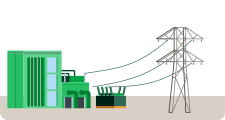
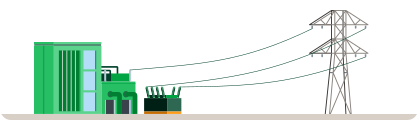
By optimising existing resources, VPPs can help reduce the need for network reinforcement and make better use of available capacity in electricity networks and other electrical infrastructure.
-
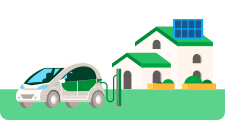

Users with batteries, electric vehicles, solar facilities or flexible consumption can participate, through aggregated and regulated mechanisms, in solutions that put their flexibility at the service of the electricity system.
The challenges facing virtual power plants
The deployment of virtual power plants offers significant opportunities, but it also presents technical, economic and regulatory challenges that need to be addressed to facilitate large-scale deployment.
-
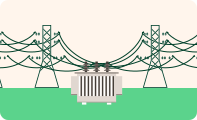
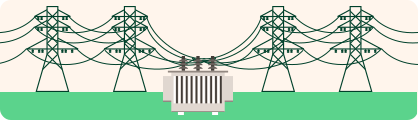
The participation of distributed and flexible resources in electricity markets and network services requires clear regulatory frameworks, aggregation mechanisms and operating rules adapted to each system.
-


Coordinating thousands of devices in real time requires advanced control and communications systems, as well as interoperability between different manufacturers and robust cybersecurity measures.
-

Setting up a VPP requires investment in technology and digital infrastructure, which can slow adoption if incentives or a supportive regulatory framework are not in place.
-


Renewable energy generation depends on factors such as sunlight and wind, so VPPs need advanced forecasting and management systems to ensure a stable supply.
Iberdrola's commitment to virtual power plants
Iberdrola is promoting electrification as an essential pathway for advancing the energy transition. This process requires increasingly flexible, digital and efficient management of the electricity system, capable of integrating growing volumes of renewable energy and responding to new patterns of consumption. In this context, the company is developing innovative energy management solutions aimed at increasing the flexibility, efficiency and resilience of the electricity network.
Against this backdrop, VPPs are emerging as a key tool for aggregating and managing the flexibility of distributed resources – generation, storage and demand – and putting it at the service of the electricity system. Their aim is to contribute to system balancing, facilitate the integration of renewable energy and progressively enable flexibility services for the distribution network, in line with developments in the technical and regulatory framework.
In the residential sector, solutions such as the Smart Advanced Assistant are helping to move towards more intelligent management of flexible consumption, such as electric vehicle charging, heating and cooling systems and other connected equipment. These digital capabilities are relevant to the future development of aggregation models, making it easier for small distributed loads to adapt in a coordinated way to energy signals or system needs.
In the industrial sector, Iberdrola is also promoting the participation of customers with the capacity to modulate their consumption through mechanisms such as the Active Demand Response Service (SRAD). These types of solutions make it possible to unlock the value of flexibility from large consumers, contributing to the balance of the electricity system and more efficient integration of renewable energy.
A notable example is our collaboration on the European Posytyf project, which analyses how renewable energy, coordinated through a virtual power plant, can help maintain the balance between electricity generation and consumption, as well as stabilise voltage in the electricity network. This initiative has contributed to Iberdrola's in-house development of this technology and was recognised with the ISGAN (International Smart Grid Action Network) Award of Excellence in 2024.
Another example is the FLEXENER project, in which Iberdrola has researched new technologies and management models to advance towards a more renewable, flexible and robust energy system. At our Innovation and Training Campus in Madrid, the project has enabled the coordination of controllable resources – such as heating and cooling systems, batteries, photovoltaic generation and bidirectional charging points – to be tested and their ability to optimise consumption and enable balancing services for the electricity system to be analysed. This experience contributes to the development of the technical capabilities needed to integrate customer assets into a VPP.
This experience has also led to FLEXIDERMS, which focuses on developing an intelligent platform capable of coordinating distributed energy resources, such as solar panels, batteries, electric vehicles and flexible consumption, so that they can operate as an aggregated resource. The project aims to facilitate user participation and explore new ways of harnessing and remunerating the flexibility these resources can provide to the electricity system, always within the applicable regulatory framework.
Virtual power plants currently in operation
Virtual power plants are no longer an experimental technology. They are entering a phase of commercial adoption and expansion in markets with high levels of renewable energy penetration and regulatory frameworks that allow distributed resources to participate.

Australia
- Australia is one of the most advanced markets, with projects connecting thousands of homes equipped with solar panels and home batteries to store energy and provide flexibility to the electricity network during periods of high demand.

Europe
- Europe, led by Germany, is at the forefront of deploying this technology through platforms that aggregate thousands of renewable energy facilities, energy storage systems and flexible consumers to optimise their participation in electricity markets.

United States
- In the United States, VPPs are growing particularly in California, with programmes based on connected home batteries that can provide energy to the network at critical times, alongside other programmes that allow users to receive incentives for providing energy flexibility.
The future of virtual power plants
Virtual power plants are not intended or able to replace traditional power stations, but they are set to play an increasingly important role in a more distributed, digital electricity system based on renewable energy.
In the coming years, VPPs are expected to evolve as a result of factors such as:
- Digitalisation through artificial intelligence: Advanced algorithms will make it possible to better forecast renewable generation and electricity consumption and optimise the operation of VPPs.
- Greater deployment of energy storage: Falling battery costs will make it possible to connect more homes, businesses and electric vehicles to coordinated systems.
- Integration of electric vehicles: Electric vehicles will be able to provide distributed flexibility and storage capacity through smart charging and, where the technology and regulatory framework allow, vehicle-to-grid (V2G) solutions capable of feeding electricity into the network.
- Active consumer participation: Users will be able to provide flexibility through their assets and consumption, using aggregated and regulated mechanisms that recognise the value of their ability to respond.
- Development of interoperability and cybersecurity standards: It will be essential to ensure that millions of connected devices can communicate securely and efficiently.
As solar and wind generation increases and the electrification of the economy progresses, managing increasingly variable generation and demand will be one of the major challenges facing the electricity system. In this context, virtual power plants will make it possible to coordinate thousands or potentially millions of distributed energy resources, providing the flexibility needed to improve stability, efficiency and the integration of renewable energy.
More about virtual power plants