


How do photovoltaic solar panels work?
What solar panels are, what types exist and how they transform light into electricity
Photovoltaic energy Photovoltaic self-consumption Decarbonisation
With more than a century of history, solar photovoltaic energy has become a renewable energy source experiencing exponential growth worldwide. According to the International Energy Agency (IEA), electricity generation capacity from renewables will double between 2025 and 2030 compared to the previous period, with nearly 80% of this increase driven by the rise in solar photovoltaic panel installations. These components have evolved from powering early satellites to becoming an increasingly common feature on our rooftops.
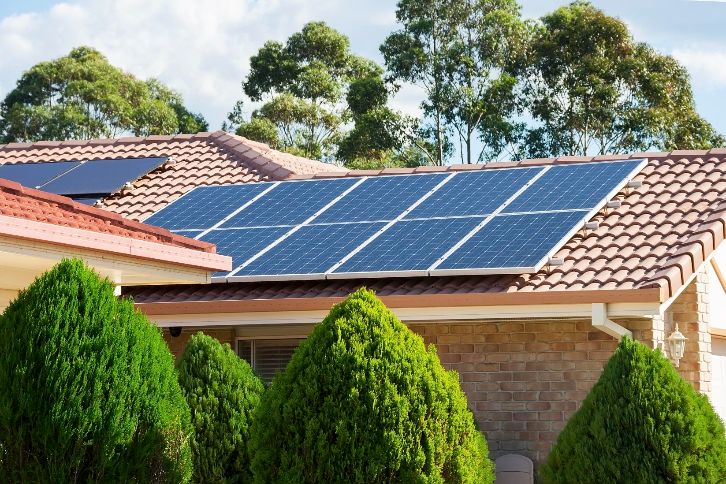
The term photovoltaic —from the Greek phos, meaning light, and voltaic, referring to the field of electricity— dates back to the mid-19th century, before the first solar cell was even manufactured. That first device had an efficiency of just 1 %, and it took decades before photovoltaic panels, devices that are capable of capturing the energy of solar radiation and transforming it into electricity for use, began to find their first applications.
Interestingly, these came hand in hand with the space race when they were used in the first artificial satellites. Vanguard 1, launched in 1958 by the United States, was the fourth satellite ever put into orbit and the first to use solar panels. As a result, it was able to continue transmitting for seven years even though its chemical batteries were depleted in just 20 days. Today, Vanguard 1 is the oldest satellite still in orbit.
Today, the growth of solar photovoltaics as a renewable energy source is following an exponential curve, making it a common source of clean, cheap electricity. The International Energy Agency (IEA) estimated that electricity generation capacity from renewables will double between 2025 and 2030 compared to the previous period (2019-2024). Total renewable capacity is projected to grow by almost 4,600 GW.
In addition, solar photovoltaics will account for almost 80% of the global increase in renewable capacity over that period. The IEA attributes its growth to the rise in retail electricity prices following the energy crisis, together with strong public policy support, which has encouraged individuals and companies to install solar photovoltaic systems. It also states that the use of distributed photovoltaic installations with storage systems is growing in countries where the electricity network is unreliable.
What are solar panels?
Solar panels are devices that capture solar radiation and transform it into usable electricity. There are two types, depending on their function:
- Photovoltaic panels: convert solar energy directly into electricity through the photovoltaic effect.
- Solar thermal collectors: harness heat from the Sun to heat water for domestic use or heating.
How do solar photovoltaic panels work and what are they made of?
To understand how solar photovoltaic panels work, it is important to note that the panels consist of multiple photovoltaic cells, and it is these cells that have the capacity to generate electricity when struck by solar radiation.
The cells, which are usually made of crystalline silicon or gallium arsenide, are mixed with other components such as phosphorus or boron that "dope" and modify their conductive properties. This creates two parts: one negatively charged and one positively charged.
It is these cells that carry out the entire process:
1. Sunlight strikes the photovoltaic cells.
2. Photons release electrons in the semiconductor material.
3. This movement generates direct current.
4. The inverter converts it into alternating current, which is the type commonly supplied to homes.
5. The electricity can then be consumed, stored or fed into the grid.

What are the plans of a solar panel?
A solar panel is made up of several parts, the most important of which is undoubtedly the solar panel - where the photovoltaic cells are located - itself. The rest of the elements aim to protect and guarantee the functionality and durability of the solar panels. Thus, the different components would be:
-

Paneles solares
Están formados por la unión, mediante conductores metálicos, de celdas o células fotovoltaicas, es decir, por los dispositivos capaces de generar electricidad cuando incide en ellas el impacto de la radiación solar.
-
Capas encapsuladas
Protegen las células solares y están compuestas de un tipo de polietileno formado por varios compuestos (etileno y acetato de vinilo) llamado plástico EVA. Este material es un gran aislante térmico al tiempo que permite pasar los rayos solares hasta las células fotovoltaicas.
-
Estructura y marco de apoyo
Normalmente suelen ser de aluminio para asegurar tanto la ligereza como la mayor durabilidad. El marco se une a la estructura que determina variables como la inclinación como la orientación del panel para asegurar que se encuentre en condiciones óptimas. Además, las estructuras sobre las que se montan los paneles fotovoltaicos pueden ser fijas, móviles, lastradas o flotantes.

How do photovoltaic solar panels work?

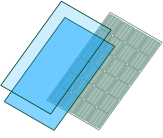
Encapsulated layers
They protect the solar cells while allowing the sun's rays to pass through to the photovoltaic cells.
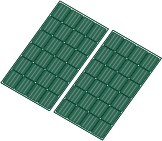
Solar panels
Formed by the interconnection of photovoltaic cells.
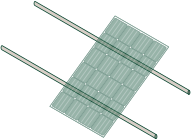
Supporting structure and framework
The framework is attached to the structure that determines the inclination or orientation of the panel.
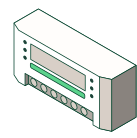
Inverters
These convert power from direct current to alternating current.
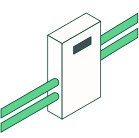
Meter or regulator
A bi-directional device that sends and receives power from the electricity grid.
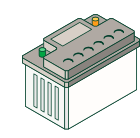
Batteries
They are optional. Useful when the panels do not receive sunlight, but also one of the most expensive items.
 SEE INFOGRAPHIC: How do solar photovoltaic panels work?External link, opens in new window.
The operation of solar panels depends on the multiple components and materials that make them up. Firstly, the encapsulated layers protect the solar cells and allow the sun's rays to reach them. Next, the photovoltaic cells, grouped into solar panels, transform solar energy into electricity. The supporting structure and frame hold the panels and determine their tilt and orientation. The inverters then convert the direct current generated by the panels into alternating current suitable for home use. The meter or regulator manages the exchange of energy with the electricity network, allowing electricity to be sent or received as needed. Finally, optional batteries allow the generated energy to be stored for use when the panels do not receive sufficient sunlight.
Types of photovoltaic solar panels and their characteristics
There are three main types of solar panels:
-

Monocrystalline
As the name suggests, these are composed of single-crystal cells. They are characterised by the fact that the silicon in the solar cells is cut into sheets, thus offering greater purity and efficiency. They are considered to be 15 to 25 % more efficient than other models. They are best recognised by their deep black colour.
-
Polycrystalline
Easily identifiable by their dark bluish colour, polycrystalline panels are obtained by melting silicon and pouring it into moulds. Their price is lower, but so is their efficiency, although good progress has now been made in reducing their reflective losses and improving their light harvesting.
-
Thin film
This is the most commonly used type of panel in housing due to its price, its homogeneous appearance and its flexibility, which allows it to adapt to all types of surfaces. They are also the least efficient, although their performance is not usually affected as much by high temperatures or shading.

Iberdrola's commitment to renewable energy
Solar photovoltaic energy is one of the key technologies in our strategy to advance towards a cleaner, more electrified and sustainable energy model. At Iberdrola, we are driving its development through photovoltaic projects in various markets, combining renewable generation with solutions such as storage and digitalisation to contribute to a more flexible and resilient energy system.
At the end of the first half of 2026, the group had 8,701 MW of installed photovoltaic capacity. In addition, our Strategic Plan 2025-2028 aims to continue strengthening this technology, allocating approximately 10% of planned renewable energy investments to solar photovoltaics. Notable projects include facilities such as Núñez de Balboa in Spain, one of the largest photovoltaic plants in Europe, and True North in the United States.
This commitment is part of our dedication to fighting climate change and transforming the energy system. By promoting renewable sources such as solar, wind and hydroelectric power, alongside electrification and the development of smart grids, we are working to build a more sustainable, secure and future-ready energy model.