


Transformer substations: what they are, how they work and their different types
What is an electrical transformer substation?
Electrical transformer substations are infrastructures that transform the electrical energy transported at medium voltage into low voltage for consumption by end users.
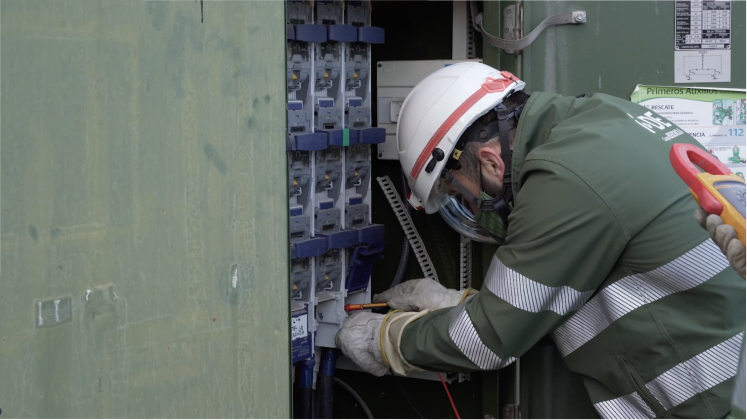
The electricity network is a complex system made up of different infrastructures responsible for transporting energy from the point of generation and distributing it to the point of consumption. For this to happen, several intermediate links are needed, and this is where transformer substations (TS) come in. Their main function is to receive energy at medium voltage (MV) and convert it into low voltage (LV), suitable for use in homes, businesses, public lighting or small industrial areas.
What’s more, transformer substations adapt, distribute and allocate electricity according to demand at any given moment. They also play a key role in the event of possible incidents on the network, as they make it possible to detect and isolate the affected section, ensuring the safety of people and installations while minimising the number of customers who may be left without supply.
This is made possible by the automation and protection technology already incorporated into the current development of smart grids.
As a general guide, a transformer substation can supply anywhere from dozens to several hundred customers, depending on its power rating and the type of demand it serves. For example, a typical urban network TS, with power ratings usually between 250 and 1,000 kVA, generally supplies approximately 100 to 500 homes, as well as nearby small businesses or services.
The difference between a transformer substation and an electrical substation
Electrical substations and transformer substations perform complementary functions within the electricity network, but they operate at different voltage levels and within different scopes. Substations operate at high voltage, connecting major sections of the network and performing electrical node, switching, protection and transformation functions between different high or medium voltage levels, without directly supplying end consumers. Transformer substations, by contrast, are located at the final stage of the distribution network: they receive energy at medium voltage from the network and transform it into low voltage, making it suitable for consumption by residential, commercial or industrial customers.
This functional difference is also reflected in their size, location and design. Substations are large-scale facilities, which may be outdoor or indoor, normally located on the outskirts of urban areas, and are designed to manage high energy flows while ensuring the safety and stability of the network. Transformer substations, on the other hand, are more compact facilities, often integrated into buildings or prefabricated modules, located within or very close to urban areas, whose main mission is the local distribution of electricity at low voltage once it has been adapted for end-user consumption.
Step by step: how a transformer substation works
We have already seen that transformer substations reduce the electrical power transported through the electricity network to levels suitable for consumption. But how does this happen?
-

Medium-voltage intake
Electrical energy arrives via the distribution network at medium-voltage levels for conversion.
-

Flow management
It then passes through the MV switchgear, which allows the network to be sectionalised, operational switching to be carried out and the installation or affected section to be isolated in the event of an incident, protecting both the transformer substation and the rest of the network.
-

Voltage transformation
The transformer reduces the voltage.
-

Low-voltage distribution
Electricity reaches the low-voltage switchboards, which distribute it through several outgoing lines to different service points.
-

Continuous monitoring
Transformer substations are equipped with protection and preventive safety systems that monitor the condition of the installation, record consumption and, increasingly, automation and remote-control systems.


Parts and components of a transformer substation
Transformer substations are made up of different elements that must work in perfect harmony to perform their function and keep the network stable.
Electrical transformer
The transformer is the main component of the transformer substation. Its role is to convert electricity from medium voltage to low voltage, adapting it to standard consumption values (400/230 volts).
In simple terms, the process works as follows: electricity enters the transformer through an input winding, which is a copper wire wound many times into a coil around a metal core. As electric current flows through this coil, it generates a magnetic field that is transmitted through the core to the output winding, another coil located on the other side of the transformer.
The key to the process is that the output winding has fewer turns of copper wire than the input winding. This difference in the number of turns is what allows the electrical voltage to be reduced: by moving from a coil with many turns to one with fewer, the electricity leaves at a lower voltage, suitable for everyday consumption.
Medium-voltage switchgear (MV)
Medium-voltage switchgear consists of equipment that allows the transformer and the associated network to be connected, disconnected and protected. It acts as a large safety switch, isolating the substation in the event of a fault or allowing maintenance operations to be carried out. Its role is essential in protecting the installation and ensuring continuity of supply.
The switchgear in a transformer substation consists of modules that group together and protect the various electrical components needed to control the flow of electricity. Inside, they house cabling, insulating elements that ensure safety and protective devices such as circuit breakers, disconnectors and fuses, which act in the event of overloads or electrical faults. They may also incorporate remote-control systems, allowing the switchgear to be monitored and operated remotely in complete safety.
There are different types of switchgear depending on their function:
- Incoming or outgoing switchgear: responsible for connecting and disconnecting the electrical energy entering or leaving the transformer substation.
- Riser bay: carries the medium-voltage cables to the switchgear busbar assembly. It does not incorporate advanced protection functions; its role is to organise, guide and mechanically protect incoming cables, ensuring a safe connection to the protection switchgear.
- Protection switchgear or circuit-breaker switchgear: designed to protect the transformer and the installation against electrical faults, such as short circuits or overloads, through the incorporation of switching and protection devices.
When the protection element is a fused load-break switch, it is referred to as protection switchgear; when the protection element is an automatic circuit breaker, it is known as circuit-breaker switchgear.
Low-voltage main switchboard (LVMS) and protection relays
Once the voltage has been reduced, electricity passes to the low-voltage switchboard, from where it is distributed to the various lines supplying homes, businesses or nearby installations. This switchboard incorporates protection systems that prevent overloads and short circuits and ensure that electricity is distributed in an orderly and safe manner.
The enclosure
This is the outer casing, responsible for protecting all the internal components of the transformer substation from exposure to external elements. Materials vary depending on the type of TS that has been built, but the most common are concrete, sheet metal or brick. It normally includes an access door for qualified personnel to carry out routine maintenance and occasional repairs, as well as adequate ventilation.
Parts of a transformer substation


1 of 6
Types of transformer substations
Although all electricity transformer substations perform the same function, they can be classified according to their construction type, which is determined by the needs of the environment in which they are installed, as well as the speed with which they need to be deployed.
Indoor
Indoor transformer substations are installed inside buildings or enclosed premises, with an enclosure that may be prefabricated or custom-built.
They are normally found in higher-density urban areas where outdoor installation is not possible. By opting for a covered installation, the safety and lifespan of these facilities is increased, as they are less exposed to external agents.
Prefabricated
This is a modular solution that is factory-built and ready for installation. These TS are usually made of concrete or metal, and their main advantage is rapid deployment without compromising safety, making them widely used in new residential developments or projects where network expansion is required quickly.
Underground
In this case, the enclosure is installed underground and accessed from the top of the installation, allowing it to remain hidden and integrate more effectively into certain urban spaces where pedestrian or vehicle traffic is required, or where concealment is desired for aesthetic reasons. In this case, good ventilation is essential for the proper operation of this type of transformer substation.
Outdoor
Outdoor transformer substations do not have an enclosure, so they offer less protection against different weather conditions. However, they are usually fenced to restrict access. They are commonly found in rural areas and near high-voltage towers.
Safety and exposure
One of the most common concerns among the public is the potential health risk associated with regular exposure to electromagnetic fields. To analyse these effects, the World Health Organization (WHO) launched an international EMF project, through which it concluded that there was no scientific evidence of harmful effects associated with this type of exposure in low-voltage transformer substations.
This same approach of scientific monitoring and continuous evaluation is reflected in the technical report titled Pilot study on environmental exposure to extremely low frequency magnetic fields (ELF-MF). Phase I, presented in 2024 by the Spanish Health Ministry. The report was based on the results of a pilot study carried out in the city of Albacete and several locations in the provinces of Cáceres and Madrid, Spain. It concluded that the average radiation level in public spaces “was 0.095µT, while in the vicinity of ELF-MF emission sources, the average environmental magnetic field level was 1.303µT, representing approximately 0.05% and 0.65%, respectively, of the 200µT limit recommended by the International Commission on Non-Ionizing Radiation Protection (ICNIRP).”