Earthing system: types, importance and installation
What is an electrical grounding system?
The earthing system is an invisible but essential element for ensuring electrical safety at home, at work or in industrial environments. Although it often goes unnoticed, its correct installation can make all the difference in the event of a fault or current deviation. Here we explain what an earthing system is for, its main components, how to identify it and the key aspects of its maintenance and verification.
An earthing system, also known as a grounding system or electrical grounding, is a safety mechanism that connects electrical installations directly to the ground to divert possible leakage currents or power surges and prevent harm to people and equipment. This mechanism is essential for reducing the risk of electric shock, as it provides a low-resistance path for electricity to dissipate safely into the ground.
What colour is the earth wire?
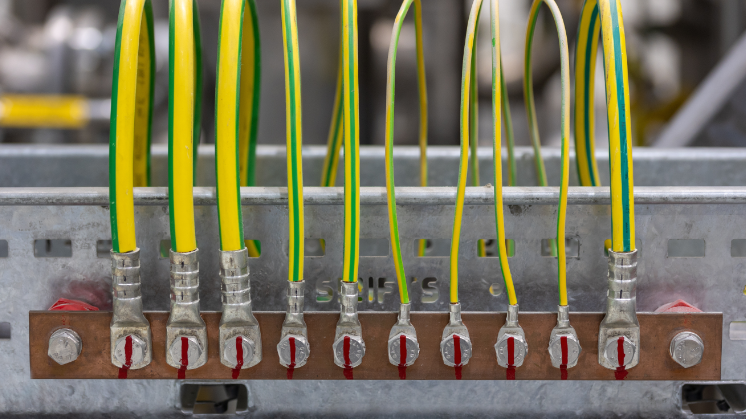
The colour of the earth wire is regulated by various international technical standards aimed at harmonising safety criteria in electrical installations. In Europe, the main reference is IEC 60446, promoted by the International Electrotechnical Commission (IEC), which establishes the use of a green-and-yellow conductor for earthing. This same code is also adopted in countries such as the United Kingdom, where national regulations (BS 7671) follow this standard.
In the United States, although the rules are set by the National Electrical Code (NEC), the earth conductor is typically green or green with yellow stripes, although in some cases it may also be bare copper.
In practice, this means that the earth wire is usually easy to recognise by its green-and-yellow colour combination in much of the world, making it identifiable even for non-specialists. This makes it easy to distinguish from other electrical conductors, such as the neutral (blue) or live wire (typically brown, black or grey). Being able to identify it is essential to avoid connection errors, carry out basic checks or detect potential issues in an electrical installation.
What is an earthing system for and how does it work?
The operation of an earthing system is based on a simple but highly effective principle: providing electrical current with an alternative, safe and low-resistance path.
Protection against electric shock and current leakage
The earthing system acts as a safe escape route for electricity when a current leak or insulation fault occurs in an appliance. Instead of passing through the human body – which could cause a dangerous electric shock – the current is diverted into the ground, where it dissipates harmlessly.
Protection against power surges and lightning
In addition to protecting against leaks, the earthing system also plays a key role in the event of power surges, whether caused by faults in the network or atmospheric phenomena such as lightning. By providing a low-resistance path to the ground, it helps channel voltage spikes and prevents damage to electrical and electronic equipment. In more complex installations, this system is complemented by specific surge protection devices to further enhance safety.
The relationship between the earthing system and the residual current device
The earthing system works in combination with the residual current device (RCD), which is designed to cut off the electricity supply when it detects a current leak. For the RCD to operate correctly, it is essential that there is an earthing path that allows this imbalance to be detected. Without a proper earthing system, the RCD may not respond quickly or effectively, reducing the level of protection. For this reason, both elements form an essential pair in any safe electrical installation.
Earthing and energy efficiency
The earthing system is also linked to the energy efficiency of modern homes. Although it does not directly reduce electricity consumption, it helps maintain the stability and proper functioning of equipment, particularly in homes with advanced systems such as heat pumps, home automation or renewable energy. By protecting devices against electrical faults and power surges, it prevents breakdowns, extends their lifespan and helps them operate under optimal conditions, contributing to a more efficient home.
Home electrification and earthing
The growing electrification of the home, with technologies such as electric vehicles, heat pumps, home automation and solar self-consumption, reinforces the importance of having a safe and well-designed electrical installation in which the earthing system plays a key role. Systems such as EV charging points, efficient climate control equipment or solar installations require adequate electrical protection to operate safely and efficiently. In this context, earthing is a fundamental element that ensures the proper functioning of an increasingly electrified home.
How to know if your home has an earthing system?
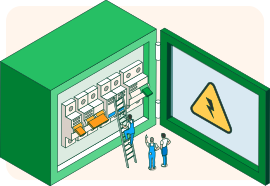
Identifying whether a home has an earthing system is an important first step from an electrical safety perspective, although full verification should always be carried out using technical criteria. In general terms, this can be checked by opening the main electrical panel (consumer unit) and confirming the presence of a green or green-and-yellow protective conductor connected to the earth bar or terminal. This indicates that the installation includes an earthing system, although this alone does not guarantee that it is functioning correctly or effectively.
From a technical standpoint, all equipment and appliances connected to the electrical network must have continuity with the protection system via sockets.
The presence of sockets with an earth connection (third pin or side contacts, depending on the system) is often used as a visual reference, as they are designed to include grounding. However, this only indicates the presence of the connection point and does not guarantee that the installation has a functional, properly sized or adequately resistant earthing system.
For this reason, reliable confirmation of the condition of the earthing system requires specific measurements (such as earth resistance) and continuity tests carried out with appropriate instruments. These checks should be performed by qualified professionals, particularly in older homes or after modifications to the electrical installation, in accordance with technical safety standards.
Risks of not having an earthing system at home
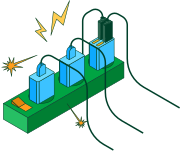
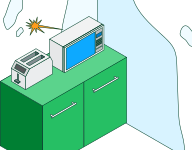
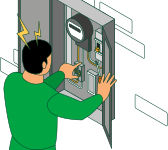
The absence of an earthing system means that the electrical system lacks one of its main protections against faults, which can lead to risks for both people and equipment. Here are the main dangers:
High, medium and low voltage
Discover their different peculiarities and uses.
Smart meters
Smart meters, a building block for the digitisation of the grid.
Energy self-sufficiency
The major challenges of self-sufficiency and energy security.
Alternating and direct current
Do you know the difference between alternating and direct current?
Is an earthing system mandatory?
Earthing is a basic requirement in current electrical regulations worldwide, although its application may vary depending on the country and the age of the installation.
In Europe, the IEC 60364 standard establishes the requirement for protection systems such as earthing in new buildings and renovations. These guidelines are adopted by organisations such as the European Committee for Electrotechnical Standardization and implemented in national regulations.
In the United States, the National Electrical Code (NEC) also requires the grounding of electrical systems and equipment, including the use of protective conductors and earth electrodes. Not all homes are required to have it from the outset if they are older, but the regulation is widely applied.
Other countries follow similar approaches: in the United Kingdom, regulation BS 7671 requires adequate earthing systems; in Canada, the Canadian Electrical Code (CEC) sets equivalent requirements; and in Australia and New Zealand, AS/NZS 3000 also mandates these protections.
As such, although there may be technical differences, the earthing system is a mandatory element in virtually all current electrical regulations due to its key role in safety.
Maintenance and system verification
Having an earthing system is not enough: it is essential to ensure that it works correctly over time. Factors such as corrosion, ageing or changes in the ground can affect its effectiveness, reducing its ability to dissipate a current.
To ensure proper operation, periodic inspections are recommended, including measuring earth resistance, checking connections and inspecting the condition of conductors and electrodes. These checks should be carried out by qualified professionals, especially in older installations or in environments where electrical safety is critical.
A well-maintained earthing system not only complies with regulations but also ensures real and continuous protection against electrical risks.
From the network to the home: quality, safety and electricity supply
The quality of the electricity supply is an increasingly important factor in a context of growing electrification. Phenomena such as micro-outages, voltage dips or fluctuations in the network can affect the performance of household equipment, particularly sensitive devices. In this regard, concepts such as supply continuity – which measures the ability of the network to provide electricity without interruptions – are key to ensuring a reliable service. Although these aspects mainly depend on the electrical network, having a well-designed internal installation, including a proper earthing system, helps protect equipment against disturbances and improves performance in the event of incidents.
At the same time, the evolution towards smart grids is transforming how electricity is generated, distributed and consumed, integrating digital technologies, self-consumption and new uses such as electric vehicles. This new ecosystem also raises challenges in terms of cybersecurity and the protection of critical infrastructure. In this context, the earthing system remains an essential, though discreet, element within the overall electrical system: a safety foundation that, together with network protections and advanced management systems, helps ensure that electricity reaches homes safely, reliably and efficiently.