


Interview with David Purón
“Iberdrola’s Global Smart Grids Innovation Hub has enabled us to validate our technology on real distribution networks”
David Purón is CEO of Barbara, a start-up specialising in the security of smart, connected devices, with investment and support from Iberdrola through our PERSEO programme. Its industrial Edge AI solutions, applicable across multiple sectors, represent a step forward for smart electricity networks, driving the transition towards a more efficient and secure power system.
 Publication: December 2025
  Reading time: 19 minutes
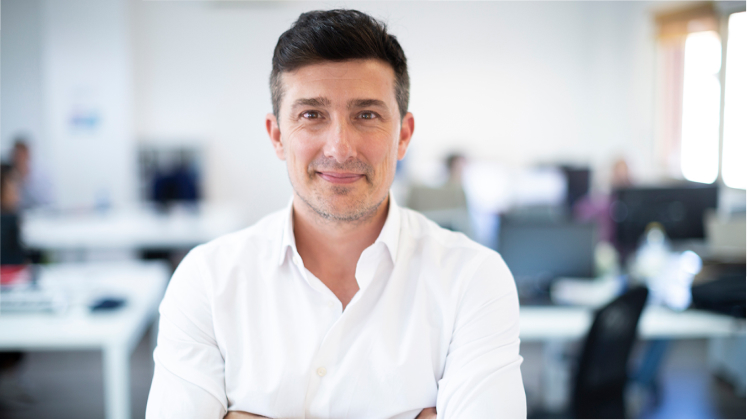
The Spanish start-up Barbara External link, opens in new window., at the forefront of digital transformation in the energy sector, forms part of the PERSEO investment portfolio, Iberdrola’s open innovation programme. Founded in 2016 in Bizkaia, the company specialises in edge computing, industrial artificial intelligence and cybersecurity solutions. Nearly a decade later, Barbara has received investment of €2.5 million from Iberdrola and Caixa Capital Risc, strengthening its international expansion and the reinforcement of smart electricity networks.
We speak to Barbara’s CEO, David Purón, who explains how the company was founded, the progress made in artificial intelligence (AI) and edge computing over recent years, and how its solutions are driving the transition towards a more efficient and secure electricity system. He also discusses the collaboration with Iberdrola, the project under way with our Global Smart Grids Innovation Hub and the company’s growth plans in Europe.
How did the idea of founding Barbara come about?
On 20 September 2016, the largest distributed denial-of-service (DDoS) attack seen on the Internet up to that point took place, bringing down global services such as Amazon and Netflix. The attack was carried out by taking control of hundreds of thousands of connected devices and using them as an “army of bots” to attack websites. It was a very clear warning of how vulnerable a world with so many Internet-connected devices could be. At that exact moment, the founding team of Barbara had just sold our previous company and realised something important: we had deep expertise in cybersecurity and IoT, and an opportunity to create a solution that could help prevent something like this from happening again in the future.
That reflection gave rise to Barbara. We started by creating a secure operating system to protect IoT devices, Barbara OS, because we understood that security had to be built in at the foundation, not added later as a patch. Over time, our own customers began asking us for more capabilities: they didn’t just want secure devices, they also wanted to manage them remotely, update software without having to travel on site, and run increasingly advanced applications on those devices. Almost naturally, Barbara OS became the core of a much more comprehensive software platform.
Today, our technology allows connected devices not only to be protected, but also to run artificial intelligence models securely. In other words, we bring intelligence to the “edge” of the network, to the points where things actually happen. We can say that the market pushed us towards edge computing even before it became a major trend.
Today, at Barbara we are at the forefront of industrial Edge AI: the combination of edge computing and artificial intelligence applied to real-world environments. What’s more, we work with an ecosystem of more than 100 partners – from hardware manufacturers to AI developers – to deliver complete turnkey projects that help industries operate in a safer, more efficient and more sustainable way.
Why are these technologies so important for improving the digitalisation of smart electricity networks?
Because electricity networks are changing radically. They used to be more centralised and predictable systems. Today, they are highly distributed networks with a huge number of connected elements: renewable generation, batteries, electric vehicles, sensors, smart meters and more. All of this generates vast amounts of data and requires fast, secure decision-making.
At Barbara, we have developed technology to capture that data from many points across the network and apply artificial intelligence models in real time. The key is that this is done directly on the devices installed on the electricity network itself, without having to send information to the cloud. This provides two major advantages: speed, because there are no delays, and security, because the data never leaves a critical environment.
We call this approach industrial Edge AI. It is an essential component for electricity networks to become even “smarter”. Thanks to it, companies can gain better visibility of what is happening, anticipate problems and manage a far more complex network efficiently.
In short, at Barbara we are helping make the electricity system more digital, more decentralised, more secure and better prepared for the future.
"At Barbara, we see artificial intelligence as the brain of the future energy system: a system that will be far more distributed and will have to make thousands of decisions every minute."
How would you explain these technologies to someone who is not familiar with the sector? How do they improve everyday life for users and companies?
We like to explain it with a simple idea: at Barbara, we install “small brains” at key points in the electricity network. These are devices similar to a computer, placed in locations such as a solar park, a wind turbine, a substation or a transformer station. There, they collect data from the environment and can run intelligent programmes, just like a smartphone runs apps, but in this case to automatically operate critical infrastructure.
What does that mean in practice? For example, an operator like Iberdrola can send an artificial intelligence model to thousands of transformer stations to predict how much energy will be needed over the coming hours. Based on that forecast, the equipment can automatically adjust to reduce losses, avoid overloads and ensure a more stable supply.
And that is just one example. What really makes Barbara special is that we turn every point in the network into an “intelligent” brain, so that the network can continuously improve with new functions, without having to replace all the infrastructure. The return on investment for electricity operators using this technology is extremely high in both the short and long term.
What can we do with smart grids today that was not possible before? What changes will users see if electricity networks become fully digitalised?
Smart electricity networks already deliver clear benefits for society: fewer power cuts, better quality of supply and a network capable of integrating renewable energy and the electrification of vehicles or climate systems without issues. But for users, once the network is fully digitalised, the impact will be very visible: much more active management of consumption and production.
Today, most users consume energy without really knowing when it is cheapest or most efficient. With smart grids, that changes. Imagine being able to tell an app: “I want my electric car to charge only when energy is cheapest or cleanest.” The network automatically coordinates that charging so that not all the cars in a neighbourhood charge at the same time and create peaks. The same applies to household appliances or climate control systems.
Another example is energy communities. If a group of neighbours generates solar energy, a smart grid can manage the exchange between them automatically and securely, following clear rules. The consumer stops being just a consumer and becomes a “prosumer”: someone who produces, consumes and decides how to use their own energy.
The same applies in industry: better control, greater efficiency and higher safety in critical processes. Smart grids enable things that were previously impossible because the network had no “digital visibility” of what was happening in real time. Now it can, and it can adapt dynamically.
How is AI contributing to the transformation of the energy sector?
At Barbara, we see artificial intelligence as the brain of the future energy system: a system that will be far more distributed and will have to make thousands of decisions every minute.
In terms of flexibility, AI already allows much better forecasting of both renewable generation, which depends on sun or wind, and consumption. If you know in advance what is going to happen, you can adjust the network to real generation and demand conditions.
In demand management, AI analyses what is happening in real time and can activate or deactivate resources such as batteries, chargers or industrial systems based on network signals or prices. This optimises consumption without compromising stability.
And in terms of security, AI is used to detect anomalies or early-stage faults. It is like having a system that “notices” something is wrong before it turns into a real failure, significantly improving resilience.
Crucially, thanks to Barbara’s edge computing, these decisions are taken locally, quickly and without relying on a constant cloud connection, which is unfeasible in such a highly distributed network with millions of connected points.
How would you explain the concept of an “Edge node” or “operating system” in simple terms?
We explain it using something everyone understands: a computer. An Edge node is basically an industrial computer installed in a specific location, for example a power substation or a factory. Like any computer, it has an operating system: just as your laptop has Windows or your phone has iOS, this node has Barbara OS.
On top of that operating system, applications can be installed securely, updated remotely, version-controlled and monitored to ensure everything works properly. In Barbara OS, we offer a marketplace with applications and AI models designed to optimise critical infrastructure.
So the idea is simple: we bring the logic of “apps on your phone” into the industrial world, but with the security and robustness required to operate electricity networks, water systems or manufacturing facilities.
"Working hand in hand with one of the world’s leading utilities helps ensure that what we develop responds to real, concrete needs."
What benefits does the collaboration with Iberdrola bring to Barbara?
For us, collaborating with Iberdrola has been key in several respects.
First, the Global Smart Grids Innovation Hub has enabled us to validate our technology on real distribution networks: substations, transformer stations and more. Working hand in hand with one of the world’s leading utilities helps ensure that what we develop responds to real, concrete needs.
Second, the Hub connects us with an open innovation ecosystem, where we collaborate with manufacturers, integrators and other start-ups. This greatly accelerates the creation of new use cases and positions us internationally. And of course, there is also the investment support from PERSEO, Iberdrola’s open innovation vehicle, which is allowing us to grow faster and compete head-to-head in a global market.
Can you give us an overview of one of your current projects with Iberdrola?
One of our most relevant projects with Iberdrola is the deployment of Barbara Edge nodes within the Global Smart Grids Innovation Hub.
These devices are already operating as virtual data concentrators for smart meters. They collect and analyse real-time information on supply quality, transformer load and asset status. This makes it possible to take decisions locally, such as phase balancing or detecting anomalies before they cause an interruption.
What’s more, our platform allows not only I-DE – Iberdrola’s distribution company in Spain – but also third parties to deploy other AI models or applications on these nodes remotely and securely. This opens the door for a substation to perform not just one function, but many, and to keep improving without changing hardware.
What other projects does Barbara currently have in the energy sector?
In addition to Iberdrola, at Barbara we are working with several electricity operators in and outside Spain that are looking to digitalise and strengthen their networks with local intelligence.
One particularly notable project is the one we are developing with Redeia, the national electricity system operator. We have virtualised a substation oscilloscope – a tool that analyses electrical signals in real time – turning it into a digital application that runs on Edge nodes in the field. This allows thousands of samples per second to be captured and accessed remotely and securely in the event of a fault, without having to send crews to site. In practice, this significantly reduces the effort and time required to resolve incidents.
Another success story is Aduriz Distribución, where we have deployed our technology in low-voltage substations. This improves real-time monitoring and enables the addition of local intelligence algorithms without renewing hardware or interrupting operations.
On the international level, we are working with ENEDIS in France at its innovation laboratory to explore various smart grid use cases. What’s more, our global alliances with industrial integrators such as Tech Mahindra are enabling us to take Barbara’s technology to projects around the world. We already have customers in 12 countries, including applications in predictive maintenance and security at solar parks in India.
Barbara has been selected in multiple international rankings, such as STL Partners’ ‘Top 50 Edge Computing Companies to Watch 2025’. What growth goals can we expect?
These recognitions confirm that at Barbara we have established ourselves as one of the most innovative players in industrial edge computing and Edge AI. They also reflect something we see every day: this market is experiencing explosive growth.
Our goals are very ambitious:
- To continue collaborating with Iberdrola, I-DE and other major utilities to bring innovation to real networks and develop projects that accelerate the sustainability of the electricity system.
- To scale our operations globally, increasing the number of managed Edge nodes and expanding into sectors such as water, natural resources and manufacturing.
- To expand our partner ecosystem to exceed a thousand applications in the Barbara Marketplace.
- To consolidate strategic alliances with global integrators and manufacturers, such as Tech Mahindra, to accelerate large-scale Edge AI deployments worldwide.
- Our objective is clear: to make Barbara a European and global benchmark in this new industrial transformation based on intelligence at the Edge.