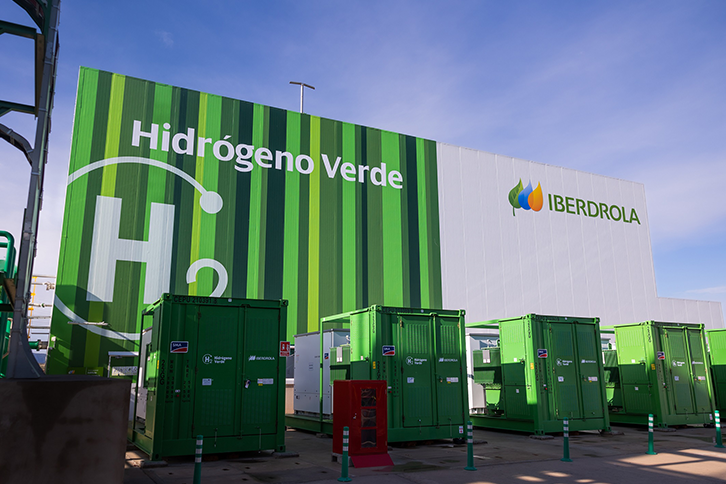
10 most relevant terms related to green hydrogen
Top 10 terms related to green hydrogen
Green hydrogen is one of the key energy sources to achieve the decarbonisation of the planet. This ambitious goal for 2050 is possible through the development of clean energy sources that contribute to the energy transition towards a more sustainable future.


Understanding key concepts related to green hydrogen and its production is essential to realise its potential to build a cleaner society. Iberdrola leads the global development of green hydrogen with more than 60 projects in countries such as Spain, the United Kingdom, Australia, Brazil and the United States, that respond to electrification and decarbonisation needs of relevant sectors such as industry and heavy transport.
Hydrogen
Hydrogen is the most abundant and lightest chemical element in the universe, with an atomic weight of 1. It is an essential element for life on Earth and forms part of all living matter, water, and is present in the Earth's atmosphere in a proportion of about 0.00005%, mainly in water vapour.
Hydrogen is also found in hydrocarbons and other compounds. It is possible to obtain molecular hydrogen artificially. The main applications of hydrogen are in industry, energy and transport.
Green hydrogen
Green hydrogen is the generation of hydrogen through a chemical process known as 'electrolysis', using clean energy sources. This method uses electrical current to separate the hydrogen from the oxygen in water. If this electricity is obtained from renewable sources, we will, therefore, produce energy without emitting carbon dioxide into the atmosphere. This is why we say that this type of hydrogen is green.
Renewable energy source
In green hydrogen generation, the electrical energy source that powers the electrolyser is crucial. Indeed, for hydrogen generation to be certified as green, it is necessary to have a 100% renewable energy source. In our case, we use renewable energy from wind, solar or hydroelectric plants.
Electrolysis
Electrolysis is a process by which the elements of a chemical compound are separated by applying electrical current. In this type of reaction, electrons are released by anions at the anode (oxidation) and electrons are captured by cations at the cathode (reduction).
More specifically, the electrolysis of water allows us to obtain the basic components of this liquid through electricity. In other words, from H2O, we obtain H2 on the one hand and O2 on the other. The source of electricity, i.e. whether it comes from renewable sources or not, is what determines whether we are obtaining green hydrogen or not.
Oxidation-reduction reactions
Oxidation-reduction reactions are chemical processes in which a transfer of electrons occurs between substances. In the specific case of water electrolysis, when applying a direct current through electrodes immersed in water (PEM) or potash solution (Alkaline), hydrogen appears at the cathode (where the electrons enter the water) and oxygen at the anode. The hydrogen gas released in this way can be used as a fuel, but must be kept separate from the oxygen; otherwise, it would result in an explosive mixture.
PEM-type reactions are best understood by explaining both the oxidation and reduction parts. The oxidation reaction is also known as 'anodic reaction', because it occurs at the anode during electrolysis. In this process, oxygen ions (O2-) are oxidised to form molecular oxygen (O2). The oxygen produced is released as a by-product of the green hydrogen generation process.
The reduction reaction is known as 'cathodic reaction' because it takes place at the cathode. In the case of water electrolysis, this is the reaction by which hydrogen ions (H+) are reduced to dihydrogen (H2). This hydrogen gas can be stored and used as a clean fuel in various applications.
Electrolyser
The electrolyser is the centrepiece of the entire green hydrogen production process. What may look like a simple industrial warehouse from the outside is actually a system of converters, stacks, gas separators, heat exchangers, valves, instrumentation and other components necessary for the electrolysis process to take place. At its heart are the key parts that cause the oxidation-reduction reactions known as 'electrolysis stack'.
Stack
The electrolysis stack is the main element of an electrolyser, it is the place where the oxidation-reduction reactions take place and, therefore, where the water molecule is broken into its elementary compounds (hydrogen and oxygen). The stack consists of electrolysis cells, and each electrolysis cell consists of bipolar plates, anode, cathode and membrane.
A single electrolysis cell produces only a small amount of hydrogen. This is why hundreds of electrolysis cells are stacked in series to obtain reasonable hydrogen yields.
By applying a DC potential difference between the anodes and cathodes of each and every electrolysis cell, the water molecule breaks and hydrogen, oxygen and heat are produced (as the process is not 100% efficient).
Compressor
Hydrogen has a high energy density per unit mass, but very low energy density per unit volume. This means that some form of hydrogen compression, liquefaction or conversion is needed along the different stages of the supply chain – from electrolysis units to conversion, storage and distribution – in order to have sufficient energy available in a reasonable volume.
If we focus on compression as a way to increase the hydrogen’s energy density, the hydrogen compressor is the main element.
The main hydrogen compressors currently in use are the following:
- Piston compressors are the most commonly used compressors for applications requiring moderate flow rates and high pressure increases.
- Centrifugal compressors are the most commonly used compressors for applications where a high flow rate has to be moved with a moderate increase in pressure.
- Ionic compressors are similar to piston compressors, but use ionic liquids instead of pistons. The advantage of this type of compressor is that it is impossible for the hydrogen to be contaminated by contact with oil.
Difference between green and blue hydrogen
The importance of hydrogen colors for the energy transition.
Puertollano green hydrogen plant
Meet the largest green hydrogen plant for industrial use in Europe.
Storage
Hydrogen storage is an essential part of the supply chain for this energy source. Hydrogen is a light and highly flammable gas; therefore it must be stored safely and efficiently. There are two types of hydrogen storage depending on its portability: stationary and non-stationary. On the other hand, it can also be stored in various forms, depending on its physical properties and the type of storage technology, including liquid, solid and gaseous storage, as well as high-pressure systems.
The most common and technologically mature form of storage is compressed gas storage. The storage pressure that can be achieved depends on the material used to make the tanks. Composite materials are currently used for the construction of these tanks in order to be able to increase the pressure and at the same time reduce the size of the container for the same amount of gas.
Hydropower
Hydrogen plants are refuelling stations that provide hydrogen as fuel for all types of vehicles, although the ones that make sense to run on hydrogen are heavy-duty vehicles (buses, trucks, ships, planes). These facilities are vital to the hydrogen-based transport infrastructure and play a key role in promoting sustainable mobility.